AllWays Traveller Features
History abounds in this very English stately home

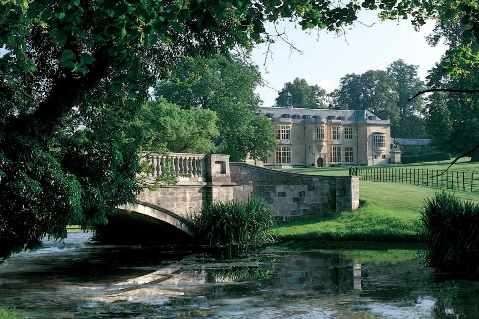
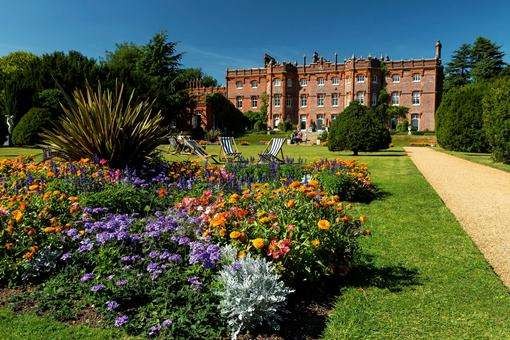
Hartwell House, one of England's finest stately homes, sits in 90 majestic acres of landscaped parkland.
It is located two miles west of Aylesbury in Buckinghamshire and about an hours drive from central London.
This truly majestic country house has been welcoming guests for centuries, including Louis XVIII, the exiled King of France who set up his Court here, away from the Napoleonic Wars, between 1809 and 1814.
Today, Hartwell House is a hotel offering guests the same high standard of hospitality in a setting that is a world away from the strains and stresses of modern day living.
The gardens at Hartwell are of great interest, especially from an historic point of view.
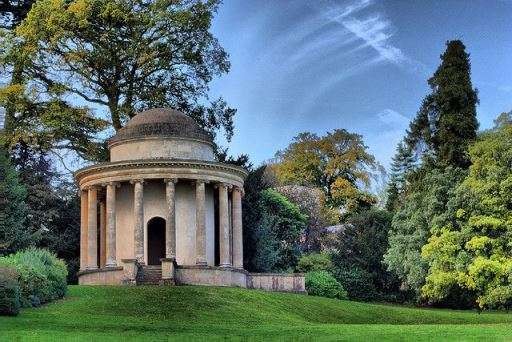
Between 1720's and 1743 an idyllic classical garden was created with, statues, obelisks and canals and this legacy can be enjoyed today.
Hartwell House is one of three grand properties been owned and managed by Historic House Hotels.
Sharing a sense of history at Hartwell House
By Ann Mealor
While there is a great deal to do in the part of Buckinghamshire where Hartwell House is located, it is a real effort to leave the house and its grounds.
The character, personality and historical significance of Hartwell is captivating.
As is the chance to spend time in somewhere that has hosted generations of royalty and aristocracy, landed gentry and the political elite.
The Great Hall
At the front of the house stands the statue of Frederick Prince of Wales on horseback beyond which, guests enter via the Great Hall, redesigned by James Gibbs between 1739 and 1740 while retaining its original early seventeenth century dimensions.
Beyond the Great Hall lies an oak-panelled room, which served as a Chapel during the stay of Louis XVIII and his court, and now serves as the bar.
Reception rooms
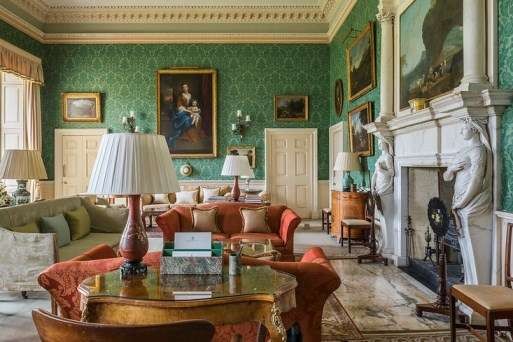
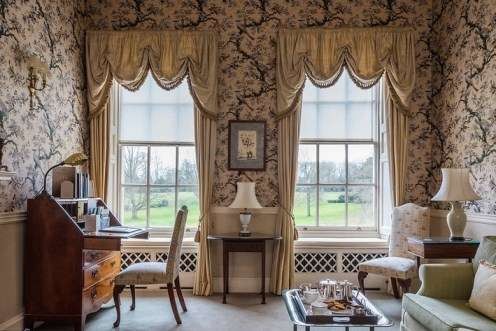
The three reception rooms on the ground floor, the Morning Room, Drawing Room and Library, which are as grand as their titles suggest, have views over the lawns.
The bedrooms
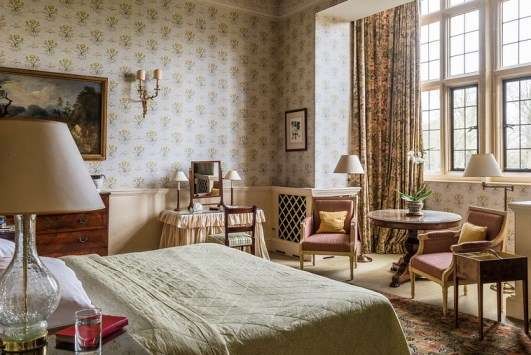
Hartwell House has thirty individually decorated and lavishly furnished bedrooms and suites on three floors in the main house.
Many of these have four-poster beds and all are decorated in a style reflecting the character of the house.
Ours was the Queen's Room, which means we slept in the same room as Marie-Josephine de Savoie, Queen of Louis XVIII.
Unlike the King, Marie-Josephine was not happy here and took to the bottle.
She died at Hartwell and was unable to take her place as Queen when Louis was restored to the throne in 1814.
Portraits of Marie-Josephine and the King, painted in Versailles in 1786, hang on the grand staircase decorated with carved Jacobean figures.
Hartwell Court, originally an Eighteenth Century coach house has been restored to provide an additional sixteen bedrooms and suites
Fine dining
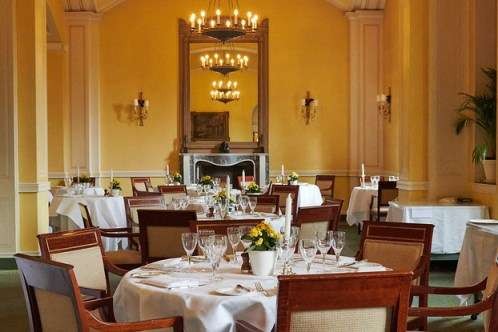
Breakfast at Hartwell House just has to be long and leisurely to set the pace for the rest of the day.
Afternoon tea, in any of the rooms or on the terrace, is as quintessentially English as one could possibly hope for.
And, finally, dining at Hartwell House is a memorable experience given the surroundings and the calibre of head chef Daniel Richardson.
Daniel works with a network of local farmers to sources the finest, fresh produce for the hotel's restaurants.
The main Soane Dining Room is based on a room in 11 Downing Street, designed by the nineteenth century architect, Sir John Soane.
Hartwell House has been awarded three rosettes by the AA, for its dining excellence.
The gardens and parklands
The 94 acres of parkland, gardens and grounds provide the perfect barrier between the house itself and the outside world.
Manicured lawns and pastures, with cows grazing, slope gently upwards to a majestic cordon of mature trees including lime and walnut trees, beech, sycamore, horse chestnut and London plane.
Completing the scene is a lake with stone bridge, a ruined church and a collection of 18th Century statues.
The spa
Hartwell Spa has a swimming pool and gym, spa bath, steam room, sauna and hot tub.
There are also a wide range of treatments.
A history of Hartwell House
By Ashley Gibbins
Hartwell House has a remarkable history, stretching back almost a thousand years to the reign of Edward the Confessor.
It was mentioned in the Domesday book and belonged to an illegitimate son of William the Conqueror.
It has been the seat of William Peveral the natural son of William the Conqueror and of John Earl of Mortaigne who succeeded his brother Richard the Lion Heart as King of England in 1199.
The court in exile
Louis XVIII's French Court in exile at Hartwell was particularly colourful.
The king was joined by his Queen, Marie-Josephine de Savoie; niece the Duchesse D'Angoulême daughter of Louis XVI and Marie Antoinette; brother the Comte d'Artois, later Charles X, and Gustavus IV King of Sweden.
King Louis remained at Hartwell until 1814 when the constitutional document, confirming his accession to the throne, was signed in the library by the King.
Beyond the Great Hall lies an oak-panelled room, which served as a Chapel during the stay of Louis XVIII and his court.It was here, as he was at prayer that word reached him of his reinstatement as king of France.
Hartwell House's proximity to Chequers, the UK Prime Minister's country residence, has resulted in it hosting many international and Government summits and gatherings.
As a result, the house has been visited by President Clinton, the Emperor and Empress of Japan, and many Heads of State.
To download a full history of the house and gardens : https://www.hartwell-house.com/hotel-gardens/history.
Out and about from Hartwell House
For those minded to venture a little further from Hartwell, take a look at some of the other properties and gardens in the area that are managed by the Trust.
Waddesdon Manor
Waddesdon Manor is a beautifully restored property built in the style of an 18th Century French château.
Formerly owned by the Rothschild family it has a fine collection of furniture, paintings, carpets and tapestries and a superb display of Sevres porcelain.
West Wycombe Park
This fine landscape garden was created in the mid-18th century by Sir Francis Dashwood, founder of the Dilettanti Society and Hellfire Club.
The gardens include a lake, temples and follies created by Sir Francis.
The mansion is among the most theatrical and Italianate in England.
Lavishly decorated, it has featured in films and television series.
www.nationaltrust.org.uk/west-wycombe-park-village-and-hill
Hughenden Manor
Hughenden Manor is a red brick Victorian mansion, which was the country house of Prime Minister, Benjamin Disraeli.
www.nationaltrust.org.uk/hughenden
Cliveden
Cliveden is an Italianate mansion and country estate overlooking the River Thames at Taplow.
As the home of Waldorf and Nancy Astor the house was the meeting place of the Cliveden set of the 1920s and 1930s - a group of political intellectuals.
www.nationaltrust.org.uk/cliveden
Stowe
Stowe Landscape Gardens in Buckingham is one of the most important landscape gardens in Britain.
www.nationaltrust.org.uk/stowe
The National Trust
The National Trust (for Places of Historic Interest or Natural Beauty) was set up in 1895.
It looks after historic houses, gardens, mills, coastline, forests, farmland, moorland, islands, castles, nature reserves, villages and pubs throughout England, Wales and Northern Ireland.
Other national trusts, throughout the world, have largely been modelled on its approach to conservation.
Historic House Hotels
Historic House Hotels was founded in 1979 to rescue and restore run-down country houses.
Through careful restoration, the houses and gardens have been brought back to life as historically accurate, yet contemporary hotels.
In 2008, the hotels were given to the National Trust to ensure their long-term protection.All hotel profits go back into the National Trust's conservation of special places.
In addition to Hartwell House, the other two properties in the Historic House Hotels portfolio are :
Middlethorpe Hall
Middlethorpe Hall is a 'William and Mary' country house some two miles from the centre of the historic city of York.
It was built between 1699 and 1701 for Thomas Barlow, a prosperous master cutler who bought the Middlethorpe estate to establish himself as a country gentleman.
Guests staying today at the 29 bedroom hotel get a genuine feel of the grand style of living enjoyed by the wealthy in the 18th Century.
The house has been carefully restored to reflect its status in the 1700s and is furnished throughout with antiques and fine paintings.
It sits in 20 acres of walled gardens, landscaped lawns and parkland with a small lake.
Middlethorpe Hall is a retreat on the edge of Yorkshire's county town and in easy reach of areas of outstanding natural beauty.
Read more : https://www.allwaystraveller.com/continents/europe/enjoy-an-18th-century-lifestyle-for-a-while-1
Bodysgallen Hall
The Grade 1 listed Bodysgallen Hall is a country house located near to the North Wales seaside resort of Llandudno.
Dating back to 1620, the tower at Bodysgallen was built as a watchtower for the low-lying Conwy Castle.
Today, Bodysgallen Hall sits in splendid formal gardens and among some 200 acres of parkland.
It still offers fine views of the Castle and Snowdonia beyond.
The Hall has a 3 AA Rosette restaurant and spa with its 50ft swimming pool, treatment rooms, steam room and sauna.
Accommodation comes in the main house itself or in converted cottage suites.
Bodysgallen Hall is a member of the Historic House Hotels group, along with Hartwell House, in Buckinghamshire and Middlethorpe Hall, in York.
Read more : https://www.allwaystraveller.com/continents/europe/lasting-memories-in-long-cherished-bodysgallen
Useful links
Location (Map)
About the author

Contact info

ISSN 2634-7032
London, United Kingdom
+44 0 7764 198 286