AllWays Traveller Features
The Helpful Winds of Heimaey

Vitali Vitaliev visits the Westman Islands off the southern coast of Iceland to find out how the islanders, and Icelanders in general, have learned to live on top of nature's own powder barrel
"Flowers are immortal, you cut them in autumn and they grow again in spring – somewhere."
/Halldor Laxness, Icelandic writer, winner of the Nobel Prize for Literature/
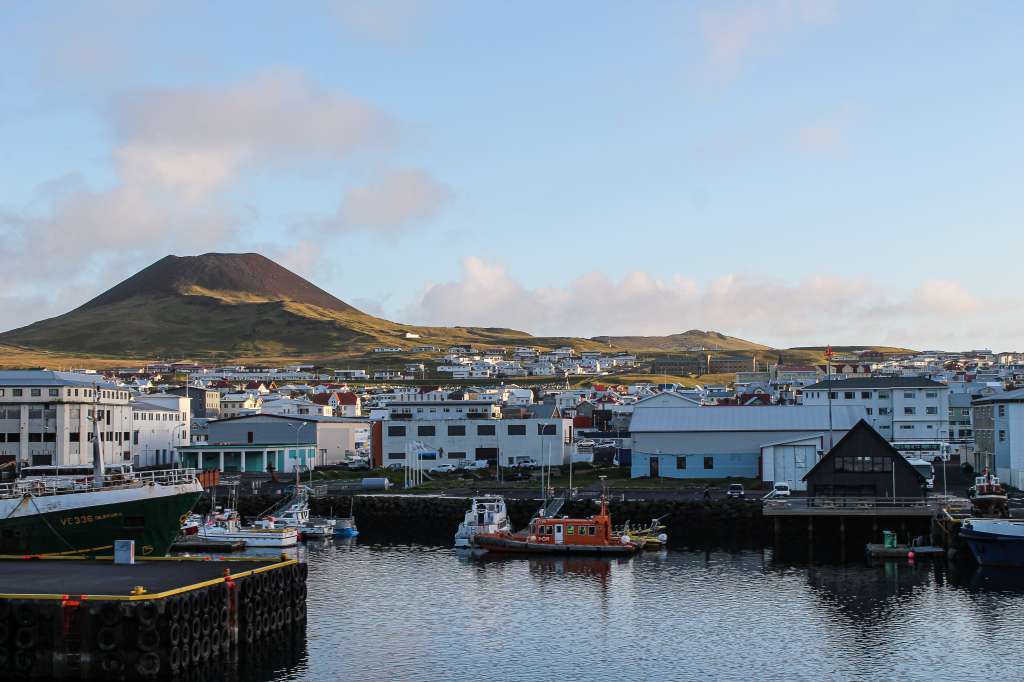
Due to never-ceasing winds, flowers do not grow on Heymaey, the main island of the rocky Westmans archipelago off the southern coast of Iceland.
Winds whistle like bullies at the top of the Stórhöfði mountain, towering above the town ofVestmannaeyjar, the Westman Islands' capital and only settlement, with the reputation of Europe's windiest place. Indeed, lighting up a match anywhere in its wind-swept hilly streets is harder than catching a puffin with bare hands... Puffins of which the island has the world's biggest colony, are also affected by the winds. With their short wings and relatively large bodies, they do not float in the sky like other birds, but flutter - balancing in the air like some reckless wave-riding surfers. The wind often takes over, and the birds' fledglings get blown off the cliffs and thrown down into the gleaming black waves, tirelessly pounding the island's ragged shore.
Winds were a blessing for Heymaey in January-February 1973 – during and after a huge volcanic eruption which nearly destroyed Vestmannaeyjar and eventually made the entire population set sail to the mainland. In the words of a witness, "When I pulled back the curtains in my bedroom, I could see a huge pillar of fire and then saw a long gaping fissure no more than 400 metres away. It was as though the earth had been zipped open…"
The lava flow was advancing slowly, and the wind kept blowing the burning ashes away from the town which helped to avoid major fires and gave the locals ample time to evacuate. Coincidentally, the same strong wind prevented the whole of the town's fishing fleet from leaving the port on the days when the 160 m-high flow of lava, tephra and tuff, having enveloped thousands of homes, was crawling towards the harbour. The stranded fishing boats were used to rescue all of Heymaey's 5300 residents.
From my impromptu vantage point, I can see the green patch of an18-hole golf course at the foot of the mountain down below. Considering the strength and persistence of the winds, the small treeless island is an unlikely spot for the slow and fairly static game of green continental valleys. Yet, to me, the very presence of a golf course on Vestmannaeyjar symbolizes the unbending spirit of the islanders – and of Icelanders in general too. Watching the unhurried wind-defying twitches of the golf players, I couldn't help remembering a similar golf course near Port Stanley, the tiny capital of another remote archipelago - the Falklands. That pitch was next to a minefield, stuffed with thousands of unexploded Argentinian mines, and was separated from it only by a row of barbed wire, with skull-and-bones "DANGER MINES" signs.
It takes a good deal of optimism and strength of spirit to be playing golf among minefields, or else, like on Heymaey - on top of a natural powder barrel (read active volcano), with a smouldering detonation cord attached.
A gateway to hell
In his 1864 novel "A Journey to the Centre of the World", Jules Verne described Iceland as a gateway to the Earth's interior. Indeed, for millions of years, Europe's second largest island has been sitting on top of the highly seismic Mid-Atlantic Ridge, separating North American and Eurasian tectonic plates. Every year, over 20,000 earthquakes and tremors of different strength are registered in the country, whose territory straddles 4 volcanic zones, 32 volcanic systems and 130 volcanic mountains. Thirty of those 130 volcanos are active, and many have erupted mightily and repeatedly throughout the years, having changed not just the shape of Iceland, but the whole of the world's history.
Laki mountain's fissure eruption of 1783 was perhaps the most "ground-breaking" – both literally and figuratively – of all. It had been happening for over eight months:from early June 1783 to February 1784, and ended up producing the largest ever lava flow on Earth – 2.9 cubic miles (!) which covered 218 square miles of Iceland's territory. Much of the country's livestock and the quarter of its human population died during the famine that ensued due to massive emissions of poisonous gases into the atmosphere.
The far-ranging impact of that natural disaster was not limited to Iceland. The huge cloud of volcanic dust, mixed with sulfur particles, was carried over much of Europe reaching as far as Egypt and North America. Due to the resulting thick fog, ships were unable to leave many a European port. Crops were also affected. According to Benjamin Franklin, a "constant fog" hung over "all Europe and a great part of North America".
The winter that followed was therefore particularly harsh, with lots of floods and famine in Egypt and in Europe, where, according to some historians, it played a decisive role in the build-up to the French Revolution of 1789! If I remember it correctly from my Soviet school's sketchy history course, 100 or so years later, Lenin called the aftermaths of wars and natural disasters, with the resulting impoverishment of the "masses", ideal breeding grounds for revolutions. Thus a volcanic eruption on a small island in the Atlantic may have changed the course of history.
That history-altering scenario came close to repeating itself as recently as in April 2010, when a powerful volcano erupted from the Eyjafjallajökull mountain in South West Iceland. The effects of this eruption, also felt all over Europe and as far as Beijing, were amplified significantly by the interaction of magma with the ice of the adjoining glacier, and most of us can still remember clouds of sticky brown dust that had brought many European airports to a stand-still. For over a week, the skies of Britain were free of any traffic. People would wake up in the morning to the eerie silence – so unusual and intense that it felt deafening. In an amazing case of synchronicity, my father-in-law, a Lancaster bomber pilot during the WWII, who was then dying of cancer at a hospital in the North East of England, passed away hours after all the UK air traffic was stopped, as if having waited for the skies to be cleared for his final "take off"...
Filming and not fleeing
On the way to Landelackyahofn – a small mainland port, from where ferries depart for Heimaey - we stopped at a small roadside "Visitors' Centre" at the very foot of the troublesome Eyjafjallajökull. Never before had I seen a mountain so sinister – a black finger-shaped peak piercing grey satin skies dagger-like. It looked as if the Polyphemus' cave, or the mythical workshop of Hephaestus, Mount Olympus' 'in-house' blacksmith and the ancient Greek god of volcanoes, could be hiding inside it.
The Visitors' Centre, staffed by the entrepreneurial family of farmer Olafur Eggertsson, attracts dozens of tourists, who are offered a guided tour of a small, yet very visual, exhibition telling the story of the April 2010 eruption, which the farmer's family had lived through. In the end of the tour, normally conducted by Grudny Valberg, Mr Eggertsson's wife, visitors are shown a 20-minute video about the eruption and its impact on the lives' of the local farming community. The movie, shot as the disaster was unveiling, is professionally photographed and edited.
"When the eruption began on the 20 of March, we were told to evacuate," Grudny Valberg told me. "But how could we abandon our whole lifestyle? We chose to stay and invited a filmmaker from Reykjavik to chronicle the event."
So, instead of fleeing, they were filming - heroism, driven by practicality!
Since then, the natural catastrophe, which brought half of Europe to a stop (with 107,000 flights cancelled for over a week), has become a substantial article of the farm's income, alongside rapeseed, wheat, barley and dairy products.
Practicality is an archetypal Icelandic trait. One has to be pragmatic to survive on these barren volcanic islands. Not only have the Icelanders learned to live on top of the proverbial powder barrel, but they have managed to turn this daily threat into an income-bringing attraction. Some tour operators even invite tourists to venture inside volcanoes. "For the first time in history, travellers have the opportunity to see what a volcano looks like on the inside. Descend 120 metres into a 4,000-year-old magma chamber and experience a new underground world," promises a daring PR brochure. In the Hrifunes guest-house near the town of Vik, where I stayed overnight on the way from the Westman Islands, the shower-room floor was made of compressed tuff – small volcanic rocks, pleasantly massaging one's foot soles. And on Heymaey itself, they found the way of heating the whole town with the energy of the cooling down lava shortly after the 1973 earthquake!
This brings us back to Vestmannaeyjar. Unlike the memorable 2010 Eyjafjallajökull disaster, whose aftermaths were felt all over Europe and beyond, the 1973 eruption of Eldfell was much more localised, but it had changed the face of Heymaey and its small community forever.
When the Fire Mountain Erupted
To get to Heymaey from Landeyahofn, we boarded a small, yet clean and comfortable, ferry boat called "Herjolfur". Apart from a dozen or so cars and several empty refrigerator trucks (they will get loaded on the islands which provide one third of the overall fish catch of Iceland), she was carrying islanders returning from the mainland and a flock of American tourists.
The crossing took under one hour. We chugged past an archipelago of barren meteorite-like rocks, skerries and islets, one of which – Surtsey – was a fairly recent addition to Iceland's and global territory, having emerged from the ocean as recently as in 1963 as a result of an underwater eruption. It took nature (or was it Hephaestus?) five days to create, and by the 15th of November 1963, the baby island was born. By the following January, it was 174 metres high – rocks grow faster than people. Unlike some other – smaller- islets that appeared briefly in the subsequent years only to get submerged by the ocean again shortly afterwards, Surtsey, named after a mythical giant Surtur, who – according to a Nordic saga – wanted to set the world on fire, was there to stay. It is closed to visitors, and only scientists are allowed to step ashore that newly formed national nature reserve.
The sight of Vestmannaeyjar, the islands' "capital", comes almost as a surprise after the boat circumvents an umpteenth craggy rock. An unexpectedly large, neat and modern-looking harbour, reputedly, the best in the south of Iceland, nestles at the foot of the Helgafell mountain, officially renamed Eldfell – the Fire Mountain - by the Icelandic Place Names Committee after the 1973 eruption. It looks as if the harbour had been there forever, whereas in fact a large chunk of it is ten years younger than even Surtsey and was added to the island's territory as a direct result of the eruption, when about 300 million cubic yards of lava and 26 million cubic yards of tephra were generously deposited on Heymayey.
The old harbour was then saved by the innovative procedure of spraying cold seawater (by 43 powerful pumps through 19 miles of plastic pipes) directly onto the hot lava. The water increased its viscosity and thus created internal barriers in the flow causing it to thicken and ride up over itself. That hugely successful experiment was later described as human history's most ambitious attempt to control volcanic activity.
The eruption stopped in early July 1973. And shortly afterwards people started returning home to Heymaey, which - fittingly - means "home island" in Icelandic. What they faced was total devastation. A number of houses were literally wiped off the face of the earth, and to reach the remaining ones, buried by tephra or set alight by glowing lava bombs, hundreds of thousands of tons of ash had to be cleared. Ironically, the rebuilding of Vestmannaeyjar was helped considerably by the additional eruption-delivered landfill material, of which there were shortages before. Plus, as I have noted already, for the first several years after the disaster, the thermal energy of the lava was harnessed and used to heat the houses – new and old. As you see, just like winds, volcanoes can occasionally be helpful...
Not the Pompei of the North
The house at Gerðistraut 10 had been buried under ash and lava for over 40 years before being excavated and turned into a museum, called – rather bluntly - "Eldheimar",the House of Fire. It was built over the carcass of the destroyed dwelling which used to belong to Gerður Sigurðadóttir. "Seeing my old home after all this time filled me with conflicting emotions… I miss my late husband, with whom we used to live there, but am happy that the excavation is now complete and the house is still standing," she said.
The Eldheimar Museum is modern, revealing and interactive. At times, perhaps over-interactive. "You can follow the destruction with joystick," reads a sign above one of the highly digitalized displays. Modern technology is, above all, an indicator of well-being. And there's no hiding the fact: Vestmannaeyjar is booming. It is now larger and much more prosperous than before the devastating eruption, which – rather ironically – was also a stimulus for renovation, helped by the thriving off-shore fishing industry. The town's high-street has a cluster of "posh" designer shops and boutiques of the kind that wouldn't be out of place in London, Paris or Stockholm. The prices are hefty, but one has to remember that every item had to be brought from the mainland. There's also a handful of excellent restaurants and bars.
According to Kristin Jóhansdóttir, Vestmannaeyjar's director of marketing, the town centre's reconstruction cost over 5.6 million euro. "Ever since the excavation began, we have put a lot of energy into rebuilding, and people all over the world have shown a keen interest in our volcanic history."
That was how she put it – "volcanic history". And in Vestmannaeyjar's case, it is not a metaphor.
"Aren't you worried that Eldfell, the Fire Mountain, will fire up again?" I addressed this question to the locals repeatedly while in Heymaye. And the answer was always the same: "We think we are ok for the next 200 years or so…". I heard that particular estimate – 200 years or so – from almost everyone. It sounded random, but having thought about it, I realized that it wasn't: 200 years spans over three-four generations: children, grand-and great-grandchildren etc. – as far ahead as the present-day islanders could allow their worries to stretch. It is easy to connect this kind of thinking with a selfish "après nous - le déluge" attitude, but it struck me as yet another manifestation of the all-permeating pragmatism of Icelandic life and psyche.
On the ferry back to the mainland, my VW was squeezed into the far corner of the car deck by an enormous refrigerator truck – the biggest I had ever seen. Loaded to the brim with Heymaey's main produce – fresh seafood, it was reeking of fish and dripping sea water.
My personal baggage, however, was not at all heavy. I was bringing back memories of the resilient island community – a taciturn, yet tough and proud, lot whom neither winds nor volcanoes could bend. Just like the "immortal" flowers of Halldor Laxness (see the epigraph), these people had to leave their island in spring of 1973 and started returning the following autumn. By then, the ever-so-helpful winds of Heymaey which had been blowing ash and the evacuees' boats away from the island, had changed direction. Until now, the islanders keep coming back to their long-suffering "home island", whose population is approaching 5000, only 300 short of what it was before the eruption43 years ago.
In PR brochures, Heymaey is sometimes called " the Pompei of the North". I find this cliché not just incorrect, but inappropriate and even insulting. The difference between Pompei and Heymaey is striking in its simplicity: the former, after all, is dead, and the latter - very much alive..
Useful links
www.discover-the-world.co.uk
Location (Map)
About the author
Contact info

ISSN 2634-7032
London, United Kingdom
+44 0 7764 198 286