AllWays Traveller Features
THE LOST WORLD OF ALASKA RUSSIANS

Vitali Vitaliev discovers a reclusive Jurassic-Park-style community of Russian Old Believers in Alaska
She was sitting on the pavement (or, as they say in America, "sidewalk"), next to a "Paws for Coffee" coffee-shop for dogs, in a wind-swept suburb of Anchorage, Alaska's biggest city. Her slanting Inupiaq eyes stared straight in front of her, across the buzzing freeway and further - past a McDonald's outlet and a grey modernistic bungalow of an "Alaska Cremation Center" - into nowhere. She was drunk. Or stoned. Or, most likely, both - alcoholism and drug-addiction are still rife among Alaska's natives. A soiled Russian Orthodox cross, carved out of whale's bone, was dangling round her dried-out parchment-like neck.
I spotted her while trying to walk off my jet-lag on my first afternoon in Alaska, although my first encounter with what is known as "Russian Alaska", or "Russian America in Alaska", occurred several hours earlier, on the flight from Minneapolis to Anchorage, where I sat next to a taciturn Alaskan Indian dressed in the black robes of a Russian Orthodox priest.
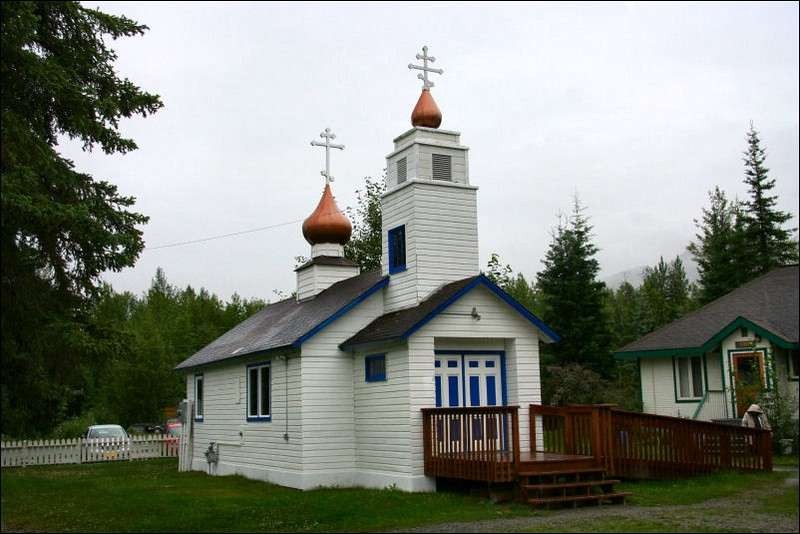
Peaceful Russian Orthodox missionaries were eventually much more successful in Alaska than bellicose communist preachers in Russia itself: communism in Russia is no more, whereas Orthodoxy in Alaska (and in Russia, for than matter) is stronger than ever, and three-bar Russian Orthodox crosses are still scratching the vast, stormy and pinkish (as if chronically inflamed and itchy) Alaskan skies from the tops of missile-shaped church domes. They have become an inseparable part of Alaska's ever-dramatic landscape, so brilliantly conveyed in the paintings of Norman Lowell, an Alaskan artist who lives on the Kenai Peninsula. His canvas "In the Stillness of the Night" features a solitary Russian church in the shadow of a snow-capped mountain, with Aurora Borealis ablaze above its roof. This artistic image is a true reflection of modern Alaska, where ethnic Russians are few and far between, but Russian Orthodoxy remains the dominant religion.
When the first Russian colonists started arriving in Alaska in the middle of the 18th century under the banner "For God and Tsar", they brought their religion with them. The locals, who used to believe in supreme divine force, proved easy converts. They eagerly took to Orthodoxy not only because of its kindness and its impressive rituals, but also because many Russian priests were highly educated people, who shared their medical knowledge with the Indians and helped them create their own alphabets by translating psalms and gospels into local languages. Soon, it became common practice for the natives to adopt the names (first and last) of their Russian Godparents after baptism. Leafing through a bulky 1999 Anchorage White Pages,I kept coming across Russian names: "Olin", "Oleksa", "Oleksyk", "Oskolkoff". Among them, there were three "Ivanovs" and six, somewhat Westernised, "Ivanoffs".
After the sale of Alaska to America in 1867 (at $7, 2 million, it was USA's ever-best bargain), many locals chose to keep their Russian names, whereas others opted for easier-to-spell Anglo-Saxon ones for secular purposes. Camille Fergusson, a young Tlingit woman in Sitka, the ex-capital of Russian Alaska, told me that her real church name was Yelizaveta. And although some aspects of the Orthodox mass are becoming increasingly Americanised ( I couldn't believe my eyes when I saw pews in the Holy Resurrection Church in Kodiak, for one is supposed to stand or to kneel on the floor during the fairly Spartan Orthodox service), and most of the liturgies are now conducted in English, some hymns and psalms are still sung in Old Church Slavonic.
Nowhere else in Alaska this peculiar fusion of cultures is so obvious as in Eklutna - a native Athabascan Indian village twenty-six miles north-east of Anchorage. On entering the graveyard of the Old St. Nicholas Orthodox Church, I was momentarily blinded by a sudden riot of bright colours emanating from the graves - the last thing one would expect at a normally sombre Orthodox cemetery. Each burial was marked not only by a traditional three-bar cross, but also by a multi-coloured "spirit house" - a transitional Wendy-house-like "dwelling" for the deceased in accordance with an ancient Athabascan system of beliefs which has no concept of physical death. The colours of these toy-houses - complete with gabled roofs, doors and tiny window-frames - differed from clan to clan, and their size was in proportion to the age of the deceased, but each of them was radiant, cheerful and (indeed!) death-defying. My baby son would love to have one in his toy-box …
Travelling in Alaska, I often thought what it would have looked like, had it not been sold to "the Boston Men" (a Russian nickname for the Americans) in 1867 and remained part of the Russian Empire - not a far-fetched historical alternative, if we remember that the sale was debated in the US Senate for over six months. There would have certainly been many more Russian names in phone directories, but fewer churches, which would have been replaced by Stalinist wedding-cake skyscrapers, with stars - not crosses - on their cheeky spires. There wouldn't have been a lot of "No Touch Laser Car Wash" stations, Aircraft Parts centres selling spare parts for privately owned hydro-planes, and ubiquitous "drive-thru" Espresso coffee shops (Espresso is America's new consumerist idol), routinely offering forty odd types of coffee, including a "half-caf" - a cross between a proper espresso and a de-caffeinated one.
One thing is certain, however: had Alaska stayed Russian (and then Soviet), it - paradoxically - would have never become home to the world's most obscure community of Russian outcasts confined to a handful of small villages (Nikolaevsk, Voznesenka, Razdolna, Kachemak-Selo, Port Graham and Nanwalek - no more than 2-3 thousand people altogether) in the south-west of the Kenai Peninsula. Visitors are not welcome there, but I was lucky (my name must have helped).
The road to the village of Nikolaevsk was overgrown with fireweed, an endemic bright-red wild flower, and pushki, a cauliflower-like poisonous plant. The latter's name was distinctively un-English and must have originated from Alaska's Russian settlers ("pushki" means "canons" in Russian). In vain, I was trying to spot a road sign for Nikolaevsk: there were none. Finally, following the instructions given to me in Homer, the nearest town, I turned into an unpaved dirt-track. After a half-hour-long bumpy ride, I was overtaken by a battered old Rover with a bearded man behind the wheel. A woman in strange Mennonite-style headwear was sitting next to him. It was my first glimpse of Nikolaevsk residents, the Russian Old Believers - a much-persecuted and therefore extremely reclusive religious group, who first came to Alaska in 1960s.
The origins of the Old Believers' movement go back to the so-called "Great Schism" of 1650s, when Nikon, a strong-minded Russian Orthodox Patriarch and a strict disciplinarian, decided to correct the Church-Slavonic holy texts and the method of worship practised by the Russian masses. His reforms were opposed by a section of the Orthodox church, who accused Nikon of heresy and vowed to stick to the old ways. Nikon's reforms were far from iconoclastic and concerned such seemingly insignificant issues as how many fingers (two or three) would be used to make the sign of the cross; whether "Alleluia" should be sung two or three times; whether the priests should walk around the altar with or against the passage of the sun, and so on. But in the eyes of the more conservative believers this constituted a huge change in their faith. Organically opposed to any reform, the Old Believers (as they became to be known) suffered severe persecution under Peter the Great, whom they saw as the Antichrist. As a result, many had to flee to the outskirts of the vast Russian Empire. After the Communist coup d'etat of 1917, a considerable number escaped over the border to China, where they stayed until the Chinese revolution of 1949 forced them even farther away from home - to South America and Australia.
The majority of Nikolaevsk residents came to Alaska (in 1968) from Brazil, via Oregon, where they survived by growing wheat and corn. In the words of Father Kondratiy Fefelov, with whom I spoke inside the village church of St. Nicholas, they left Brazil because of its poverty ("We couldn't sell our crops") and Oregon - in fear of the "corruptive influence" the American media, mainly television, could have on their children, traditionally brought up in strict accordance with the Old Believers' religious values. "We wanted to get away from Western civilisation, with all its drugs and sexes (sic), and to be on our own…"
"How come you allow this?" I asked him pointing at a satellite dish on the roof of a neighbouring house. The priest waved his hand nervously: "We had to slacken up eventually. You ban television - and the kids run to our American neighbours, or go to the cinema, which is even more dissipating…" He pronounced "cinema" with disgust - in precisely the same way the Old Believers of Peter the Great times must have uttered the hated word "reform".
With 11 children and 36 grandchildren, Father Kondratiy, to whom the villagers reverentially referred to as Batiushka (Little Father), knew what he was talking about.
Children were everywhere in Nikolaevsk, where each family had 10-15 off-spring (it is not unusual for a girl to get married at 14 or 15). They were all serious, quiet and too shy to talk to a stranger like myself - particularly the girls in their traditional long dresses ("talichkas") and coloured kerchiefs, which they were bound to change for a more sophisticated headwear ("shashmura") - a cap covered with a scarf - after getting married and becoming "khoziaiki" ("house-hostesses"), preoccupied mainly with cooking and child-bearing. Marriages in Nikolaevsk have still to be approved and blessed by the "Batiushka".
And yet, the feared Western civilisation has crept its way into this closed anachronistic world. "We have a problem with young Russian village guys who are in the habit of getting drunk and driving their pick-up trucks at breakneck speed across the town," a tourism official in Homer confided in me. When I asked the "Batiushka" about it, he pretended he didn't hear the question. In a challenge to the age-long traditions of male domination, several Nikolaevsk women found themselves jobs in Homer, whereas a couple of others chose to leave the community altogether and moved into the "real world", where, as one Nikolaevsk resident told me with horror, "they wear shorts and even use make-up". On the other hand, three American families came to live in Nikolaevsk and seem to be getting along well with the Russians.
Yet even the most conformist of the Old Believers cannot dismiss all the fruits of Western civilisation as harmful. The "Batiushka" himself was telling me with pride about the villagers' own small fleet of ultra-modern fishing vessels, with latest electronic equipment (fishing contitutes their main source of income). Nikolaevsk boasts an excellent secondary school, one of the best in Alaska, where all the subjects, except for Russian, are taught in English. No wonder,the village teenagers prefer communicating in English, although most of them retain a reasonably good command of their melodious old-fashioned Russian language. As for smaller kids, they hardly speak any Russian at all. "They don't want to learn Russian," complained Nina Fefelova, at whose house I was put up for the night. Nina, herself an Old Believer, came to Nikolaevsk from the Russian Far East seven years ago and married one of "Batiushka's" sons, a deacon called Denis. She taught Russian at the village school.
A bubbly and outgoing character, Nina was not devoid of a business streak and ran a tiny Russian gift-shop from her own back-yard. She made me wear a traditional Russian "rubakha" (a collarless silk shirt) and a "kushak" (sash), both borrowed from her shop, and kept snapping pictures of me in this ridiculous (from my point of view)outfit, now only worn by dancers of Russian folk ensembles when on stage.
In the evening, I was invited to watch fish-canning in the courtyard of Feopent Ivanovich Reutov, a thick-set elderly man, who was born in Russia ("My parents didn't tell me where") and grew up in Brazil. The canning was done in an antediluvian way: tins of pink salmon were placed into a capacious iron barrel with water and boiled for 4 hours on a powerful bonfire - "to kill all the microbes". Two youngsters, Iona and Flegon, both duly bearded (the Old Believers' men are not allowed to cut their facial hair) and wearing baseball caps, came to help.
A neighbour, Father Deacon Josip, popped in, allegedly, to borrow a scythe and stayed.
I felt at ease in the company of my fellow outcasts, who seemed to accept my "Western" attire, my "modernised" Russian language, my shaven beard-less face, even my camera (the Old Believers are notoriously camera-shy). There was only one thing about me that they could not come to grips with: smoking. "In Voznesenka, they would attack you with an axe, if they saw you with a cigarette in your mouth," Iona told me with a grimace of disapproval on his face. I made a mental note never to come close to the village of Voznesenka, which had a reputation of being even more reclusive and more conservative than Nikolaevsk.
They told me off, when I inadvertently dropped a cigarette end on the grass: "Pick it up and hide it somewhere. If the Batiushka finds it, you are in trouble…"
"Don't you realise that smoking is a sin?" Josip, the Deacon, persisted. I mumbled something to the effect that we were all sinners in one way or another. "This is true," Josip said pensively, and the subject of smoking was dropped for the rest of the night, although the word "sin" came up again, when Flegon mentioned his girlfriend, an American divorcee with a child.
"We must ask the Batiushka to marry you and to take you out of sin as soon as possible, in the name of Jesus Christ, our saviour," Iona, who himself was properly married to an Old Believer Russian girl, commented. "He must be joking," I thought, but Iona's face was dead serious, and his dark-brown eyes were full of sad reproach.
… A warm and velvety summer night fell upon Nikolaevsk fast, as if the smallish village was suddenly covered with an oversized black and fluffy ushanka (a traditional Russian fur-hat with ear-flaps) from Nina's gift-shop. The fire was burning brightly in Feopent Ivanovich's courtyard tearing the darkness into shreds, dagger-like. Iona produced a bottle of raspberry-flavoured (we were in America, after all!) Smirnoff. All the men, except for me, crossed themselves before every drink.
Deacon Josip was telling us about his childhood in Brazil. And although he had never been to Russia, his Russian speech was amazing: it was the language of Tolstoy and Turgenev, free of foreign borrowings and clumsy modern abbreviations. Like their life-style and customs, the Old Believers' mother-tongue was frozen in the time warp of 1917-1920, when their grandparents, with bags and baggages and under cover of darkness, crossed the Russian-Chinese border into Manchuria.
Merciless and insatiable Alaskan mosquitoes were buzzing above our heads, and some big dark shadows were moving in the bushes, behind the lawn. Could they be the moose?.. I felt as though I was watching a perfectly directed (by Andrei Tarkovsky?) Russian movie set in in the middle of the last century. Only this "movie" was for real, and I myself was among the cast …
It was already past midnight, when Josip and Iona burst into a heart-rending Russian folk-song which I had never heard before. They sang about long farewells, dusty roads and a hard life in foreign land, which in Russian is called "chuzhbina" - a word that doesn't have a direct equivalent in English. Contained in it are willows rustling soothingly above the winding creek, the wind whistling through a birch grove, and an endless snow-covered Russian steppe glistening like marble under the moon.
I suddenly understood why, after centuries of wanderings, these people chose to settle in Alaska, which looks so deceptively similar to their cruel, yet dear, homeland - the country that most of them have never been to and will never see. Like Russia, Alaska has willows above creeks, snow-covered plains, and birch-groves. It used to be a part of Russia and, in a sense, it still is, for the genuine Russian spirit destroyed by the Bolsheviks and no longer found in Russia itself, has been smuggled out and kept intact here by the Old Believers.
Looking at their faces, lit by the last flashes of the dying bonfire, I knew: they had found their new home for many years to come. I remembered a memorial plate which I had seen earlier at the Nikolaevsk School Assembly Hall:
"In Commemoration of the Old Believers Who Became United States Citizens," it said.
Dozens of old-fashioned Russian names followed...
Useful links
About the author
Contact info

ISSN 2634-7032
London, United Kingdom
+44 0 7764 198 286