AllWays Traveller Features
Winchester layers history on history

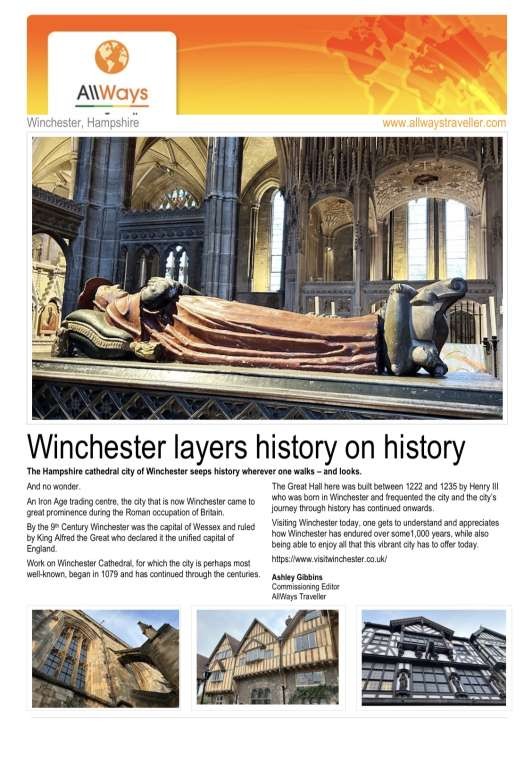
The Hampshire cathedral city of Winchester seeps history wherever one walks – and looks.
And no wonder.
An Iron Age trading centre, the city that is now Winchester came to great prominence during the Roman occupation of Britain.
By the 9th Century Winchester was the capital of Wessex and ruled by King Alfred the Great who declared it the unified capital of England.
Work on Winchester Cathedral, for which the city is perhaps most well-known, began in 1079 and has continued through the centuries.
The Great Hall here was built between 1222 and 1235 by Henry III who was born in Winchester and frequented the city and the city's journey through history has continued onwards.
Visiting Winchester today, one gets to understand and appreciates how Winchester has endured over some1,000 years, while also being able to enjoy all that this vibrant city has to offer today.
https://www.visitwinchester.co.uk/
Your AllWays leading to Winchester
Download the full version of your AllWays leading to Winchester to your smartphone or tablet.
Or read on.


Alfred the Great leads us forward and back in time
Winchester's historic longevity plays a major part in the city's lure as a short break destination
By Ashley Gibbins
Those I had spoken to all assured me it was a fine city and well worth a visit.
A musical introduction
I also knew of Winchester Cathedral from an early age, thanks to the 1966 pop song by the New Vaudeville Band.
It was one of the singles I bought with my first trench of pocket money. (The other two were Paperback Writer by The Beatles and The Monkees I'm a Believer).
Even now when I say, or indeed think, of Winchester Cathedral it is with the musical lilt from that song of so many years ago.
(Check it out on YouTube).
A vibrant city with a pedigree
With Ann and I now having greatly enjoyed a short break in Winchester, I know I was right, but also what I have been missing, all the these years.
A bustling, vibrant city with an historical pedigree that is simply astonishing.
Alfread still leads us in his city
Walking into Winchester, from one of the long-stay car parks, the first thing to catch the eye is likely to be the five metres high statue of Alfred the Great (849–899) on an eight metres plinth of white Cornish granite.
Alfred, he of 'burning the cakes' infamy, stands with shield by his side and a sword held defiantly and hilt up in his right hand.
Alfred, had 'Wintanceaster' as his Wessex Kingdom capital and, as such, it became the de facto first capital city of England, when he unified what were the separate Anglo-Saxon Kingdoms.
First things first
I mulled a few short seconds over Alfred's memorial, wondering what size of statute and plinth might be deemed suitable for my own achievements and where it would be placed.
It was then a few steps along The Broadway and into the tourist information centre, the first stop whenever visiting a new place.
This time it was the oh so knowledgeable Catherine who listened to what we were hoping to get from the visit before offering the perfect itinerary backed up by maps marked with walking routes, and a selection of leaflets.
We would, of course make the cathedral a priority, while also taking in the City Museum, Great Hall and Westgate and take a look at 878 AD Anglo-Saxon immersive experience.
Catherine also suggested a walk through the water meadows that circle one side of the city, if the weather suited.
This would take us to the ruins of Wolvesey Castle, which was the old Bishop's Palace and onto the Medieval Hyde Abbey before walking back into town past Winchester College.
In addition to its historic importance, we also found Winchester to be a small city with real charm and character.
There are any number of excellent cafes and restaurants along with cosy wine bars and tremendous English pubs.
It all provided for an excellent first foray into Winchester.
Time at Winchester Cathedral should not be skimped
An American couple told me they spent four hours in the cathedral - and it was still not enough.
I was sure we would not need anywhere near as long. Particularly as religion does not play a part in my life.
But I was wrong, very wrong.
Awe inspiring
Winchester Cathedral itself is a truly monumental achievement, and one cannot fail to be awed by is size and magnificence and the way it has been stanchion in nearly 1,000 years of history.
There is also the chance go down into to the massive vaults of the Cathedral's early Norman crypt, which has a reflective sculpture by Antony Gormley.
For the more active, the climb up the Cathedral Tower offers fine views across the city and surrounding countryside. There is also the chance to walk the Nave roof with its huge wood beams.
Evensong is held daily in the Cathedral, which also stages classical concerts, open-air theatre, art, light and sound- installations and a Christmas Market.
First things first
An absolute priority on arrival is to get an escorted tour from one of the wonderful and ultra-knowledgeable volunteer guides.
The tours, included with the admission fee, are invaluable and give a real appreciation of the great historical importance of where we are.
It's also a chance to understand the timelines from when William the Conqueror first ordered a cathedral to be built, in 1097, how the Gothic-style nave was added in the 14th Century and the Great Screen stone feature behind the altar in the 15th century.
And to ask as many questions as you wish – all answered.
The tour is likely to end at the start of the 20th century, when parts of the cathedral were sinking due to soft foundations.
Local hero
Diver, and true local hero, William Walker worked underwater daily for six years to reinforce the foundations with over 25,000 bags of concrete.
It is then the chance to stroll the cathedral, one of the longest in Europe, and take what else there is to see in Winchester Cathedral.
This includes :
- the Winchester Bible : an astonishingly illustrated manuscript produced in the city between 1150 and 1175
- he 17th-century Morley Library : comprising the collection of Morley Bishop of Winchester between 1662 and 1684
- the Mortuary Chests: thought to contain the remains of Saxon kings and bishops, and
- Jane Austen's Grave: the final resting place of the author.
These are just a few of the many the things that absorbs one during a visit.
Leaving Winchester Cathedral I felt slightly ashamed that I ever doubted the Americans.
More information
https://www.winchester-cathedral.org.uk/
Many other historical and cultural attractions on offer
While Winchester Cathedral is the most popular visitor attraction in the city it is by no means the only one.
We took advantage of the Historic Winchester-Super-Explorer pass (pay once visit all year) that is offered by the Hampshire Cultural Trust.
The Trust is an independent charity that manages many of Hampshire's historic and cultural attractions.
In Winchester these are the City Museum; the Great Hall and Westgate Museum and 878AD
Winchester City Museum
A visit to Winchester City Museum starts with a large-scale model of the city during Victorian times and, over three floors, takes in its origins as an Iron Age trading centre, Roman Winchester and its Anglo‑Saxon heyday.
There is the reconstruction of a mosaic floor from a Roman villa and artifacts from each era.
The museum will be of particular interest to Jane Austen fans.
In May 1817, Jane travelled to Winchester to seek medical help but died two months later, aged just 41, at 8 College Street and was buried in Winchester Cathedral.
There are only a handful of items that survive today which actually belonged to Jane, and the
The Great Hall with Westgate Museum
The Great Hall and the nearby Westgate are all that remain of Winchester castle built by William the Conqueror.
That said, The Great Hall is one of the country's finest medieval halls and displays the Round Table of King Arthur, which was in fact built in the 13th Century and painted later on the instructions of Henry VIII.
The nearby Westgate, which was a fortified medieval gateway to Winchester, today houses a museum telling the story of the building along with the history of Tudor and Stuart Winchester.
It displays a painted ceiling commissioned by Winchester College for the visit by Mary Tudor and Philip of Spain after their marriage in Winchester Cathedral in 1554.
Weather permitting, the roof top also offers great views over the city.
Perhaps most fascinating, however, is evidence of the 150-year period between the 16th–18th centuries when the Westgate was used as a debtors' prison.
One can see the graffiti etched by those imprisoned there into the stone walls and carved into the oak floor.
878AD
Finally, Hampshire Cultural Trust runs 878 AD, a state-of-the-art indoor interactive experience that transitions into Winchester Revealed, an app based themed walking tour of the nearby historic parts of the city.
878 AD is the year the Anglo-Saxons faced a decisive battle with the invading Vikings for the control of Wessex and we are taken to the eve of the battle by stunning video depiction and live actors.
With the Vikings defeated it's onto the streets, app in hand, on a game styled quest.
More information
https://www.hampshireculture.org.uk/
A countryside stroll to England's most perfect almshouses
A walk through the water meadows is a delight on pleasant days
We started our walk with a quick visit to the Winchester City Mill, apparently the oldest working water mill in the UK, before taking to the water meadows footpath and by the River Itchen.
Wolvesey Castle
The route is clearly sign posted and has a first stop at the ruins of Wolvesey Castle, the one-time palace of the Bishops of Winchester.
Built in the 12th Century it was one of the greatest medieval buildings in England, one befitting the powerful and wealthy status enjoyed by the bishops of Winchester.
The palace remained in use until the 1680s, when the then Bishop George Morley built a new palace next door.
Take advantage of English Heritage's fascinating audio commentary.
The Hospital of St. Cross
Walking on from the castle through the meadows, one follows the Itchen to the Hospital of St. Cross and Almshouses of Noble Poverty.
A Grade I listed building it has been described as England's oldest and most perfect almshouses.
It was built in 1136 by Henry of Blois, Bishop of Winchester and grandson of William the Conqueror, it is open to the public.
Winchester College
From here it is a leisurely walk to Winchester College, founded in 1382, and back to cathedral.
The College welcomes visitors daily to its museum, Treasury and on guided tours.
More information
https://www.english-heritage.org.uk/visit/places/wolvesey-castle-old-bishops-palace/ and https://www.winchestercollege.org/
A place to stay in Winchester
The voco Winchester Hotel & Spa
While the voco Winchester Hotel & Spa is just a five-minute drive from the centre of historic Winchester it is also a short drive to the quintessential country towns and villages of the South Downs.
By Ann Mealor
The hotel is a colourful, comfortable and contemporary base for exploring this picturesque part of the country.
A former Holiday Inn, it became voco following a recent and very tasteful, multi-million pound refurbishment.
The reception, lounge, restaurant and bar are laid out as one large, open plan space but it is made interesting, cosy and scandi-style homely through clever design, soft furnishings, lots of greenery, stylish lighting and plenty of objets d'art.
It's a great place to sit and work on the laptop or relax with a coffee or glass of wine, on your own or with friends.
On arrival we were given a little treat of two buttery lavender shortbreads in environmentally friendly packaging.
Our room
Our executive, first floor room was smart and newly decorated in blue and natural tones.
The hotel has good 'green' credentials- its high-quality bedding is made from 100% recycled materials and the luxurious, beautifully fragranced Antipodes toiletries, used throughout the hotel, are 100% natural.
Dressing gowns and slippers were in the wardrobe, a refillable glass bottle of filtered water on the desk along with tea, coffee, Nespresso machine, hot chocolate and biscuits.And a little bottle of long-life milk, so much better than the usual cartons.
A nice touch was the complimentary wine and snacks in the minibar - a feature of all the executive rooms.
I also liked the retro telephone and the large mugs, which meant I got a decent sized cup of tea first thing.
Dining at voco
We ate in the voco's restaurant, Kitchen 21 on both evenings.
We hadn't planned to do so, but our meal on the first night was so good we decided to eat there again.
Kitchen 21 provides modern, casual dining, and is known for its 21-inch pizza. We didn't get to try it this visit, but maybe next time.
I chose the sirloin steak with cherry tomatoes, portobello mushroom and fries.
The steak was tender and at my request, cooked medium-well, exactly to my liking.
The chips were crunchy and piping hot.
Ashley had a flaky, sauteed cod with wild mushrooms, olives, broccoli and chips.
Both dishes were delicious.
We finished off with a dessert each – a decadent, creamy, crunchy Eton Colada and a traditional Apple Charlotte with a warm sauce anglaise.
Breakfast
Breakfast was a tasty and very enjoyable affair, thanks to Christine the chef, who made omelettes to order.
Hot, fluffy and filled to bursting with cheese, mushrooms and onions.
They were so good we had them again the following day.
Also on offer was a hot buffet of bacon, sausages, beans, black pudding, hash browns, tomatoes and mushrooms.
There were veggie options along with freshly baked pastries, thick sliced bread for toasting, cereals, cheese, cold meats, crusty bread, fresh fruit, juices tea and coffee.
As well as the omelettes, the breakfast team deserve a special mention as not only were they very efficient, but they were also friendly with a great sense of humour.
Cheerful banter was had with chef Christine as she sauteed, swirled and grilled and with Sharron who cleared and tidied tables whilst telling us about her small holding and Alpacas.
Sharron had a large tattoo of her favourite on her leg, which she took great pride in showing us.
Dogs are welcomed at voco and a special canine package with treats bedding etc is available for £25 a night.
The voco also has the Ana Spa with treatment rooms, a Hydro-Pool, Himalayan Salt Sauna, Sensory Shower, Crystal Steam Room and a Bubble Foot Spa.
This is a hotel that both leisure and business guests will feel equally at home in.
https://winchester.vocohotels.com/
More information :

Location (Map)
About the author

Contact info

ISSN 2634-7032
London, United Kingdom
+44 0 7764 198 286