AllWays Traveller Features
Great Dixter, Sussex : Picturesque Perfection!

All I can do is, write from the heart, which won't be hard! I do apologise for my excessive use of exclamation marks, but I'm sure you'll forgive me!
I recently went on a coach trip to Great Dixter with our local U3A group.
They're a worldwide group with many activity groups and events. More about them another day.
We approached the house and separated as I was going in the house, while the rest of the group headed for the gardens. The front porch rivalled the Leaning Tower of Pisa.
We've just had a loft conversion done, and I'm sure that if the Council Surveyor ever came to Great Dixter, he'd be on his knees, sobbing!



A brief history of Great Dixter
Great Dixter was bought by Nathaniel Lloyd and his wife Daisy in May, 1910, for £6,000.
Edwin Lutyens was the chosen architect, beating other architects who wanted to modernise it into a Victorian country house. Lutyens and Lloyd discovered a wreck of a 16th century timber house a few miles away, which they bought and had carefully demolished and moved, where it was added to the Great Dixter house.
As the house was closed for the day and all the voluntary guides were off, I was the only visitor in the house. Wonderful!
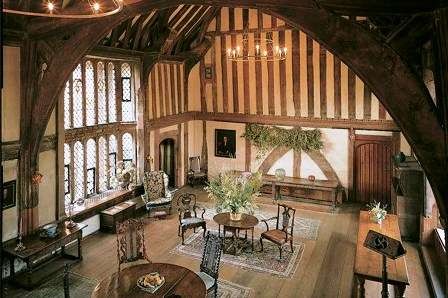
I stood, gazing around me in the Great Hall.
Medieval features
Alterations were made there in 1595, but they were removed in 1911, leaving the hall as it was originally, with all its Medieval features. It's one of the only surviving timber-framed halls in the UK, and it's stunning!
I had an aunt who would have looked at it unmoved and said, How do they dust it up there? Sadly, as I stared upwards, I could hear her voice saying it. I told you I was going to write from the heart, didn't I?
To the right, a door leads to the Parlour, which was used by the family in Medieval times to escape from the Great Hall. Daisy Lloyd used the Parlour as her quiet room, for writing and working on her skilled embroidery.
To the left of the Great Hall, a staircase goes up to the Solar. It was the main private part of the Medieval house.
It seemed so full of life that I half-expected the Lloyds to come in, followed by a maid carrying a tray with tea and scones on it!
A mish-mash
The room is a mish-mash of unmatching furniture. Magazines are stacked on tables, the bookshelf is full, and logs are piled in the fireplace.
Nathaniel and Daisy had six children; five boys and one girl, and the solar is a real family room.
Ellie Cochrane, my guide, who looks after group bookings, symposia and study days, told me that the house is used for entertainment, but not weddings, and the staff can come upstairs, light a fire and relax in the evenings.
Lucky, lucky staff!
Back in the Great Hall, I was greeted by Perry Rodriguez, the Estate Manager.
It's quite unusual to meet people who are content in their work, but Perry is very happy and bursting with enthusiasm!
How wonderful to leap out of bed in the morning in perfect surroundings, eager to get started. What a great job!
A friendly ghost
I asked Perry if there are any ghosts in the house, and he said that there's a definite atmosphere that he sometimes senses. But it's not scary; it's a warm, friendly atmosphere, with good vibes.
If it is a ghost, it seems to love having people in the house.
There's a large, brick-lined well outside, but most of the water comes from a relatively new bore-hole.
A Dowser was used to find the water, and he was overwhelmed by the power of the ley-lines.
We said goodbye to Perry, and Ellie took me to the other half of the house to see the kitchen and the old Servants' Hall and Dining-Room.
The kitchen, which is virtually unmodernised, is used all the time. A big black kitchen range fills one wall, and there's the oldest working fridge that I've ever seen!
Several members of staff live in the house, plus students and apprentice gardeners.
I went outside to explore the gardens. They're just how I think gardens should be, packed with plants that overhang the paths.
Oh the colours
Perfumes waft gently and just out of reach in the air, with an underlying whiff of fox. And oh, the colours!
Doctors should be encouraged to give out tickets to Great Dixter instead of anti-depressants or painkillers. I'm sure that a day spent wandering around there can cure a thousand ailments.
But be careful if you bend down to sniff any plants as you may get stung on the nose by a bee. They're buzzing around everywhere!
At the end of the garden there's a basic but well-stocked café, with good fresh coffee and delicious home-made cakes. And there's a souvenir shop next to it.
There's also a large nursery with a huge selection of the garden's plants for sale. So you can leave your nail scissors at home, ladies!
Oh yes, I spotted a few hastily hidden handbags and guilty grins. But it was easy to tell the naughty ones; they walk around saying the names of the plants in Latin!
Great Dixter is not owned by the National Trust. It's under the stewardship of the Great Dixter Charitable Trust.
Some 30% of its money comes from fundraising, and it couldn't survive without donations.
Great Dixter House and Gardens,
Northiam, Rye,
East Sussex,
England.
TN31 6PH
Tel 01797 252878
Open Tuesday-Sunday, 11am-5pm.
Useful links
Location (Map)
When you subscribe to the AllWays Traveller, we will send you an e-mail when there are new updates on the site so you wouldn't miss them.
About the author

Contact info

ISSN 2634-7032
London, United Kingdom
+44 0 7764 198 286