AllWays Traveller Features
Springtime serenity on the Llangollen

Outstanding natural beauty
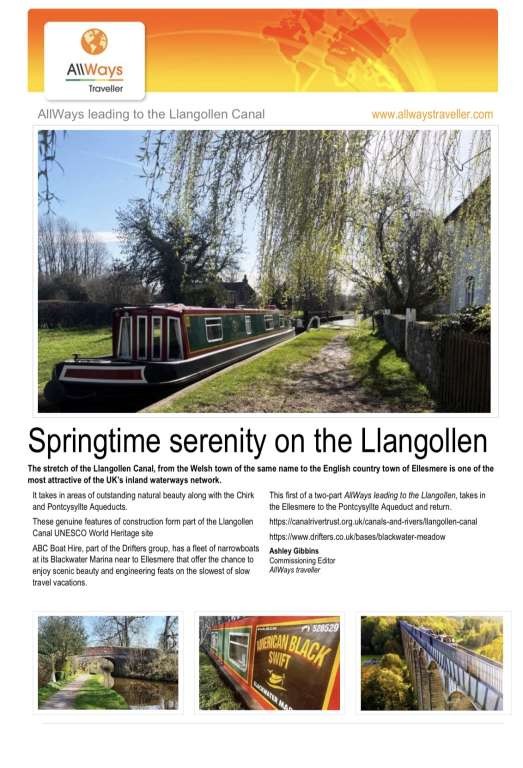
The stretch of the Llangollen Canal, from the Welsh town of the same name to the English country town of Ellesmere is one of the most attractive of the UK's inland waterways network.
It takes in areas of outstanding natural beauty along with the Chirk and Pontcysyllte Aqueducts.
These genuine features of construction form part of the Llangollen Canal UNESCO World Heritage site
ABC Boat Hire, part of the Drifters group, has a fleet of narrowboats at its Blackwater Marina near to Ellesmere that offer the chance to enjoy scenic beauty and engineering feats on the slowest of slow travel vacations.
This first of a two-part AllWays leading to the Llangollen, takes in the Ellesmere to the Pontcysyllte Aqueduct and return.
https://canalrivertrust.org.uk/canals-and-rivers/llangollen-canal
https://www.drifters.co.uk/bases/blackwater-meadow
Your AllWays leading to the Llangollen Canal
Download your copy of the full version of AllWays leading to the Llangollen Canal to your smartphone or tablet.
Or read on.


Embracing the narrowboat way of life
Ann and I are becoming real narrowboat enthusiasts and if not yet true aficionados we are certainly getting there.
By Ashley Gibbins
This was our fifth trip on a narrowboat (see below) and we found the Llangollen Canal, to be one of the most alluring so far.
The waterway meanders for 46 miles from Llangollen in Denbighshire, in North Wales to Hurleston in Cheshire, via the historic market town of Ellesmere, Shropshire.
We decided to opt for the stretch from the Blackwater Meadow Marina at Ellesmere to Llangollen Basin back, some 37 miles.
It would take us through two locks, two tunnels and a lift bridge in either direction, so no problems there.
And stunning countryside all the way, much of it designated an Area of Outstanding Natural Beauty.
We would also get to cross over the Chirk and Pontcysyllte aqueducts, which form part of the Pontcysyllte Aqueduct & Canal UNESCO World Heritage Site (see below).
These are achievements in their own right.
With all that's on offer along this stretch of the Llangollen, it is inevitably very popular with boaters and can get a little congested in high season.
But go in early spring as we did, or in fall, and it offers a serenity that is absolutely beguiling.
An industrial waterway
The Llangollen was opened as a mercantile and freight waterway in the early 1800s, a time when Britain's canals formed the backbone of the Industrial Revolution.
Horse drawn narrowboats would ply the canal with cargos of coal, iron and other raw materials.
The arrival of the railways saw trade go into gradual decline and the Llangollen became redundant as an industrial canal by the mid-1940s.
The Llangollen Canal was only kept open as a water supply, but this meant it was still there when interest in canals for leisure and recreation took off in the 1950s and 60s.
The canal's waterway and its towpaths were restored and day and holiday visitors were lured here in ever increasing numbers.
The Canal & River Trust, a national charity, took over the management of the Llangollen Canal from British Waterways in 2012, when it was given responsibility for 2,000 miles of waterways in England and Wales, with the associated infrastructure.
The future of the Llangollen Canal was secured, with the Trust's ongoing programme of enhancement works ensuring this wonderful canal can be enjoyed by all.
American Black Swift is 'just the job'
For our trip we had the American Black Swift, a 49ft narrowboat from ABC Boat Hire's base at the Blackwater Meadow Marina.
One of their 13 strong fleet at the marina, she sleeps up to four people, was easy to navigate and was ideal for the two of us.
Before pulling out, we were given a thorough, interesting and very necessary overview of the boat and its operation by ABC's Sandra.
We talked through our plans for the trip and checked with her, where the locks, tunnels and winding (turning) holes were.
Doing this before pulling out we know what's what and where's where.
In doing so it became clear our original thinking that we would get getting to Llangollen Basin and back in four nights was 'doable' but would mean 'pushing it'.
This, of course, defeats the 'slow travel raison d'etre for time on a narrowboat.
We decided therefore to reign in our aspirations and opted instead to turn around once we had crossed the Pontcysyllte Aqueduct, an experience must for boaters on the Llangollen.
It was a wise decision.
With our Pearsons Canal Companion as an invaluable guide to the Llangollen, our time on the canal, with no rush or panic whatsoever.
Our four nights on the American Black Swift were memorable, and we were able to fully embrace this wonderful canal and its long, winding stretches of glorious countryside.
However, because we did not get to Llangollen, this is our AllWays leading to the Llangollen Canal (part one).
We will have to return to complete the trip to Llangollen Basin in spring of next year.
That is certainly going to be no hardship.
Making the most of our time on board
We now welcome the splendid isolation that the self-sufficiency of narrowboat life offers and come evermore well prepared to wine and dine onboard.
By Ann Mealor
When we first took to the canals, we planned to stop at quaint country pubs en route for hearty evening dining.
Our onboard provisions were therefore geared to breakfast and lunch, though this never quite worked out.
To begin with, we didn't always reach our planned destination and had to moor up for the night in the middle of nowhere.
This meant relying on our emergency rations to silence our rumbling stomachs!
There were also times when the pub we had planned to stop at wasn't serving food that night.
We usually found this out after a half hour walk along the towpath, and back again, in semi-darkness.
And, if the weather was miserable, we were reluctant to leave our cosy cabin.
Putting on waterproofs and boots and getting blasted by rain on a quick march to the pub is never an appealing prospect.
Finally, there weren't always as many pubs within easy reach as we thought and sometimes those that were did not meet our expectations.
Changing tack
We therefore began taking extra food to eat on board, and found we enjoyed this as much, if not more than going out.
You can always go to a pub, but it's not often you get the chance to eat on a narrowboat.
Sipping a chilled glass of wine in a snug, warm cabin or on deck enjoying the country scenery on a balmy evening is wonderful.
Our cooking skills aren't great, and facilities and space are naturally limited, but we work with this.
We now take 'easy to prepare' items like bread, sliced cheese, baked beans, soup, eggs, quiche, tomatoes, crumpets, teacakes and ready meals.
The fridge is stocked with wine, olives and dips and cupboards with crisps, nuts, fancy biscuits, crackers and breadsticks.
It is fun seeing what can be created from what is available.
Ashley and I really do enjoy our meals on board.
It is so relaxing, just being moored up, enjoying leisurely evenings in our comfy wear and slippers!
We also take our own glasses, for the fizz, and have fake-flame candles and our own music on Bluetooth to create atmosphere.
Books, magazines and crosswords keep us happily occupied.
On our next trip, we will be doing more of the same and may get a little more adventurous with our cuisine.
Even if this is just adding truffle flavoured crisps and smoked salmon to the menu - and mustn't forget the lemons for the G&T's!
A masterpiece of creative genius
The Pontcysyllte Aqueduct and Canal UNESCO World Heritage Site is an 18 kilometre long is a feat of civil engineering of the Industrial Revolution, completed in the early years of the 19th century.
By Ashley Gibbins
Pronounced Pont-ker-sulth- tay, the Welsh for the bridge that connects, it was completed by Thomas Telford in 1805 and features the 126-foot-high Pontcysyllte Aqueduct.
This is Britain's longest and highest navigable aqueduct.
When granting World Heritage status UNESCO explained :
It covers a difficult geographical setting, and the building of the canal required substantial, bold civil engineering solutions, especially as it was built without using locks.
As such the aqueduct is a pioneering masterpiece of engineering and monumental metal architecture.
The use of both cast and wrought iron in the aqueduct enabled the construction of arches that were light and d strong, producing an overall effect that is both monumental and elegant.
The property is inscribed as a masterpiece of creative genius, and as a remarkable synthesis of expertise already acquired in Europe.
It is also recognised as an innovative ensemble that inspired many projects all over the world.
The Chirk Aqueduct
Chirk Aqueduct is part of the UNESCO World Heritage Site, and a scheduled ancient monument in its own right.
In addition to being canal architecture at its finest, it offers the chance to stand with one foot in Wales and the other in England.
Chirk tunnel, just along the towpath and known locally as the Darkie was one of the first to have a towpath.
https://whc.unesco.org/en/list/1303/
https://www.pontcysyllte-aqueduct.co.uk/
https://canalrivertrust.org.uk/canals-and-rivers/places-to-visit/chirk-aqueduct
https://www.pontcysyllte-aqueduct.co.uk/attraction/chirk-aqueduct-and-tunnel/
Chirk Castle and Garden
As with our other narrowboat excursions, we look to bolt on a trip to a nearby National Trust property.
This time we were fortunate in being able to moor and stroll up through the 480 acres of estate parkland with sheep, cattle and veteran trees to Chirk Castle
The whole estate is located within the Area of Outstanding Natural Beauty also designated a Site of Special Scientific Interest, being a habitat for rare invertebrates, bats, fungi and wildflowers.
The castle, at its heart, was originally built around 1295 on an outcrop above the convergence of the Rivers Dee and Ceiriog.
One of a series of castles during the reign of Edward I, its role was to subdue the last princes of Wales and any rebellious inclinations they might have.
Some three hundred years later, Chirk Castle was bought by Sir Thomas Myddelton in 1595 and has passed through the Myddelton line of descendants to the present day.
Visiting today one can admire a 17th-century Long Gallery, three furnished 18th-century State Rooms, the servants' hall and the Chapel Music room.
The five acres of garden, immediately surrounding the castle are a delight.
One can enjoy manicured lawns, yews and herbaceous borders, along with rose, shrub and rock gardens and a terrace with views over the Cheshire and Salop plains.
https://www.nationaltrust.org.uk/visit/wales/chirk-castle
The National Waterways Museum
As were in the area and having said our fond farewells to the American Black Swift, we ended this narrowboat excursion with a short drive to the National Waterways Museum, at Ellesmere Port.
By Ashley Gibbins
Located at the Ellesmere Port Docks, in Cheshire, it was designed by Thomas Telford in the 1790s, so a fitting link to the Llangollen.
Run by Canal & River Trust, the museum preserves some of the Uks key historic boats and details the story of how canal waterways made a such vital contribution to Britain's Industrial Revolution.
It features listed Victorian warehouses, locks, and workers' cottages, showcasing the area's history as a major industrial transshipment hub.
The idea for a waterways museum was first 'floated' in the early 1970s, when a group of passionate canal enthusiasts met and formed the North Western Museum of Inland Navigation.
The new 'Boat Museum' was officially opened in 1976 and taken over by the Canal & River Trust, in 2012, along with 2,000 miles of inland waterways in England and Wales.
In addition to its permanent exhibitions and displays, the Museum stages an annual programme of special events including its Easter Historic Boat Gathering and Steampunk and Vintage Vehicle Weekends.
Costumed characters bring the old docks 'to life' on several Canal Town Sundays through July and August.


Location (Map)
About the author

Contact info

ISSN 2634-7032
London, United Kingdom
+44 0 7764 198 286