AllWays Traveller Features
Transiting the Suez Canal

Travelling through the Suez Canal is a great adventure that takes in an enormous amount of history and will appeal to those with a particular interest in maritime affairs, or who just like being at sea.
It can be undertaken on one of the many cruises that travel between Europe and Asia, or on one of numerous cargo ships that take a limited number of passengers.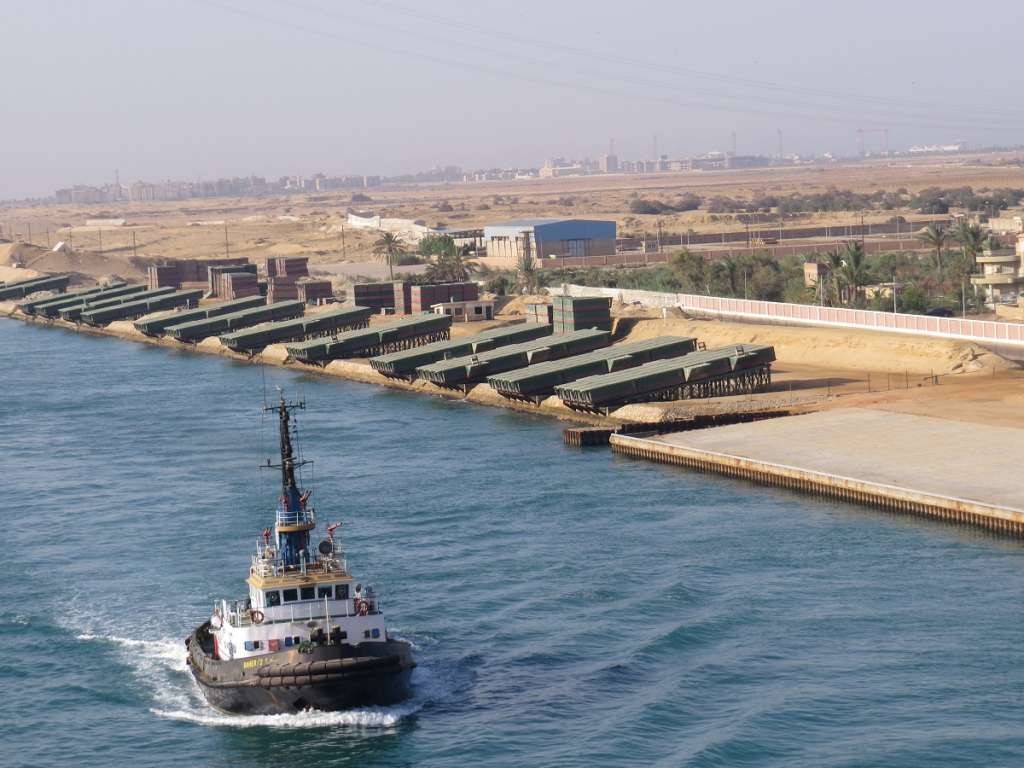
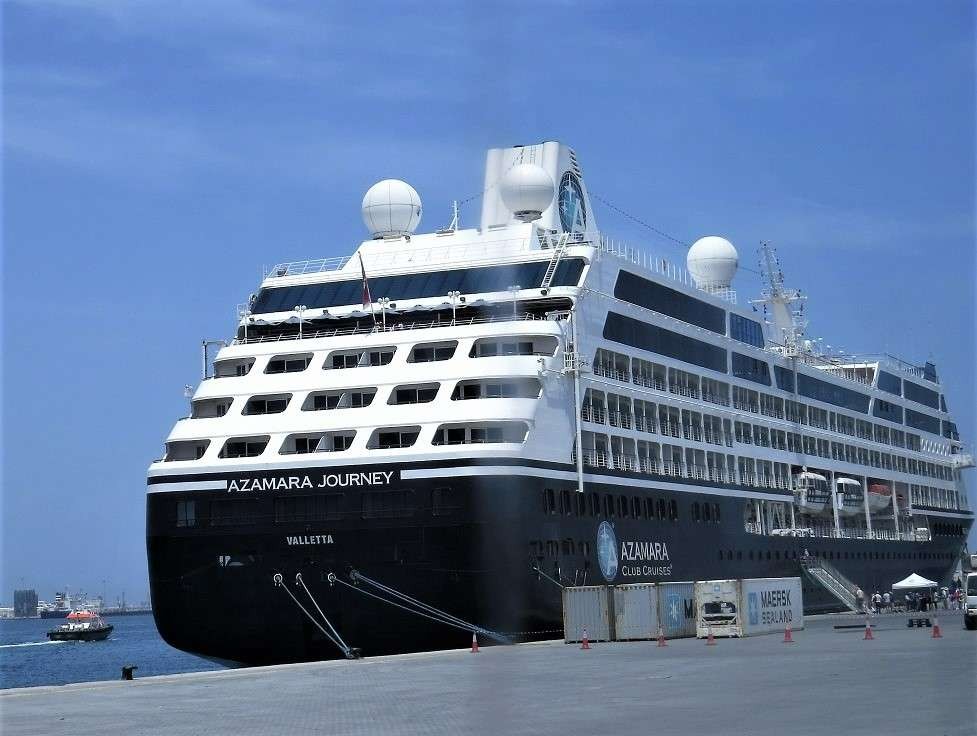
At the time of our cruise on Azamara Journey from Mumbai to Athens, Somali pirates were active in the Gulf of Aden and around the Horn of Africa and cruise ships had taken to travelling with elite, specially trained, armed security guards. Ours boarded the ship in the UAE and stayed with us until we were well into the Red Sea. It is because of measures like these that there has never been a successful pirate attack on a cruise ship, whereas there have been numerous occasions of cargo ships and yachts being boarded and held to ransom.
Long history
The Suez Canal stretches 193 kilometres or 104 nautical miles from the city of Suez at the southern end, to Port Said on the Mediterranean Sea. The canal separates the Egyptian mainland from the Sinai Peninsula. It took 10 years to build and was officially opened on November 17, 1869. Unlike the Panama Canal, the Suez Canal is open cut and single level without locks.
The Suez Canal connects the Mediterranean Sea to the Indian Ocean via the Red Sea, providing a more direct route for shipping between Europe and Asia. It enables passage from the North Atlantic to the Indian Ocean without having to circumnavigate the African continent, reducing a 21,000 km journey taking 24 days to a 12,000 km journey taking 14 days.
The original Suez Canal Company was a joint British-French enterprise, but the canal is now owned and operated by the Suez Canal Authority of Egypt. The canal is open for ships of all countries to conduct international trade, and for leisure travel, but it has been closed or blocked five times and has been at the centre of some major global conflicts. An average of 70 ships navigates the canal daily, based on last year's total figure.
Navigation
Three convoys of ships are allowed each day, two southbound and one northbound. The original canal did not permit two-way traffic and southbound ships would stop in passing bays to allow the non-stop passage of ships in the northbound direction. Under this arrangement it took from 11 to 16 hours to travel the length of the canal.
In 2014-15, the Egyptian government oversaw an $8 billion expansion project that widened the Suez from 61 metres to 312 metres over a 34-kilometre distance. The project took one year to complete and, as a result, the canal can now accommodate two-way traffic over much of its length.
Despite the widening the Suez Canal remains vulnerable to accidents. In March 2021 during a windstorm, the 400-metre-long container ship Ever Given lost forward control and ran aground on both banks of the canal, blocking it for six days. More than 100 ships at each end of the vital shipping lane were stuck there for almost a week before salvage crews could refloat the stricken vessel.
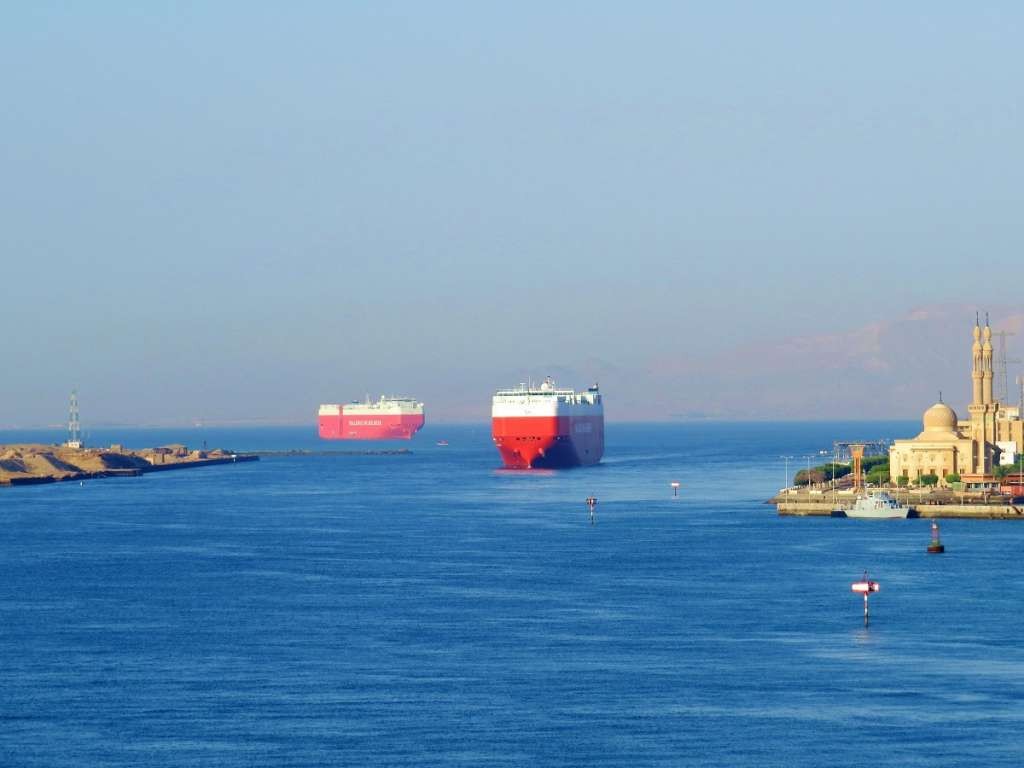
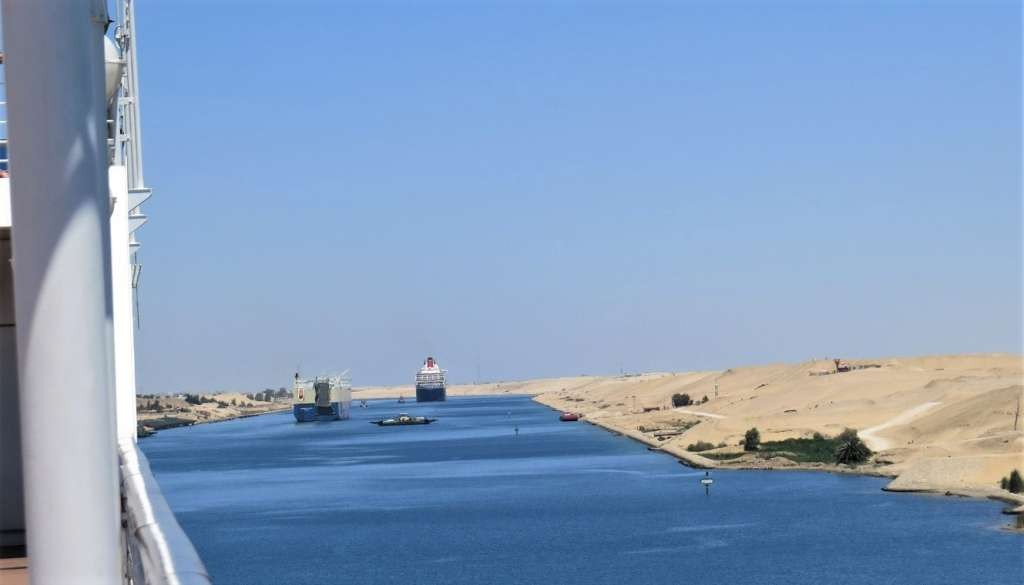
Ships arrive at their allotted times and join a queue to enter the canal. Our cruise was northbound and we entered the canal at about 6am. Taking on board a pilot is mandatory, but the assistance of tugs is optional. Ships proceed at a maximum speed of 8.6 knots, approximately one nautical mile apart. The distance narrows if the ship in front of yours is travelling slowly, as was the case with the car carrier immediately ahead of us in the picture below. Ahead of it with the red funnel can be seen the Cunard ocean liner, Queen Mary 2.
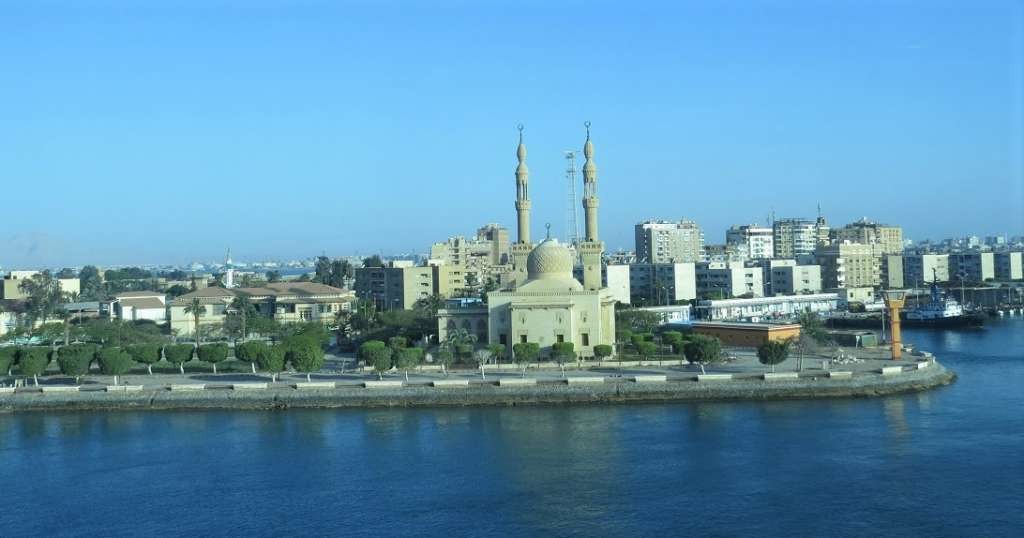
As you pass the city of Suez, one of the first notable sights is the Port Tawfik Mosque on the left or port side when you're travelling north. Its ornately decorated domed roof, called a qubba, sits between its two minarets.
Apart from the landmarks you see during the transit, it's worth looking out for daily life on the canal and its banks.
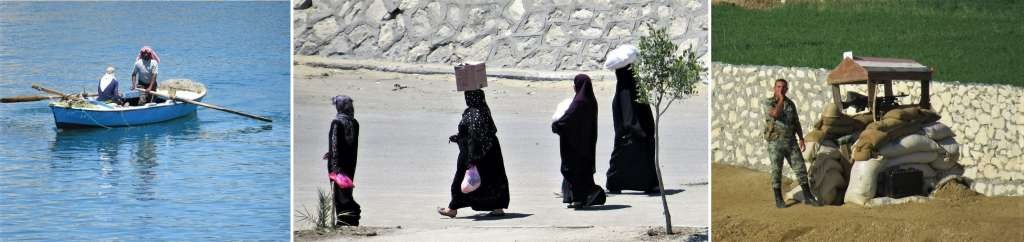
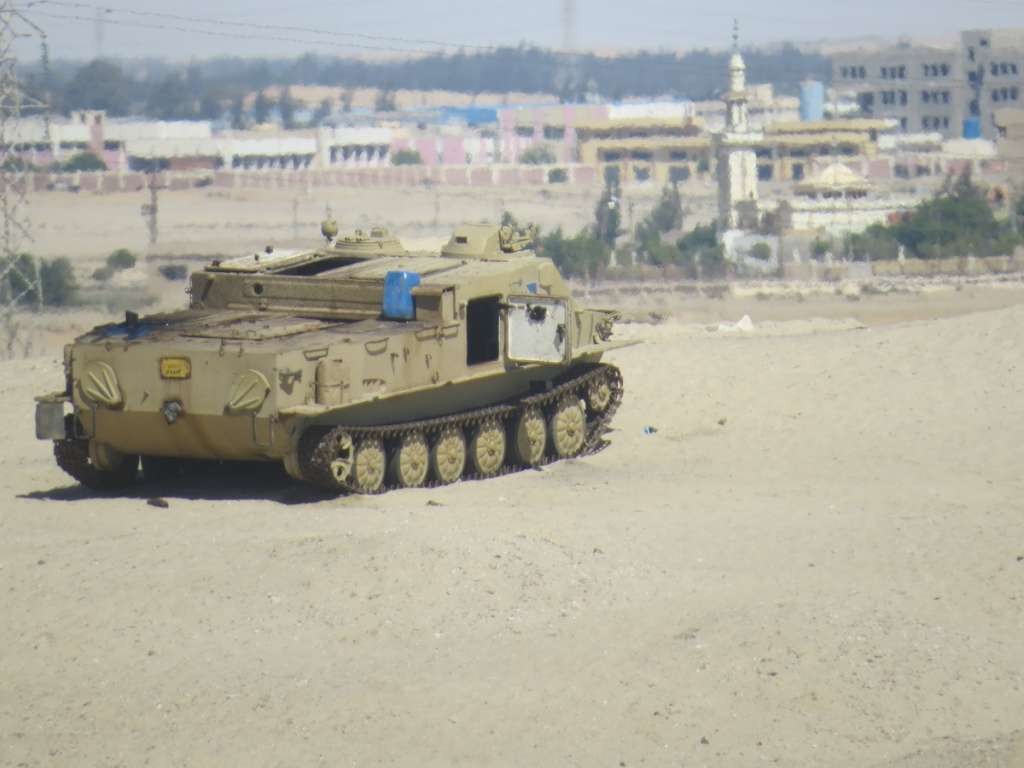
As always in this part of the Middle East security is tight and nowhere more so than along the banks of the Suez Canal. No one wants any incident to affect the operation of the canal.
As you head towards the city of Ismailia, the Defence Memorial of the Suez Canal can be seen on the port side. This 50-metre-tall granite obelisk is dedicated to the defence of the Suez Canal against the Ottoman army during World War I.
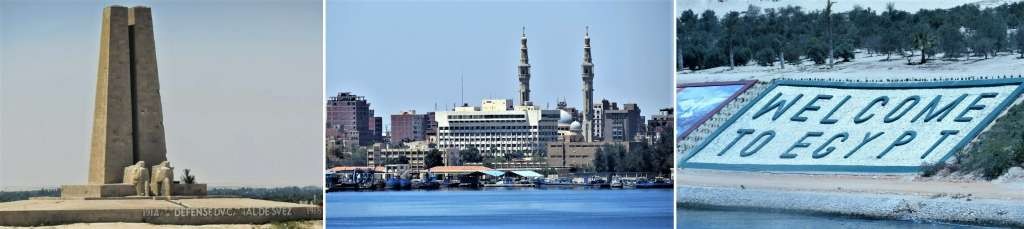
The city of Ismailia was founded in 1863 during the construction of the canal. The head office of the Suez Canal Authority is located in Ismailia on the shore of Lake Timsah.
As you near Ismailia, you are greeted with an enormous 'Welcome to Egypt' sign and the Suez Canal Authority Monument on the starboard side. At this point we are about halfway through the canal.
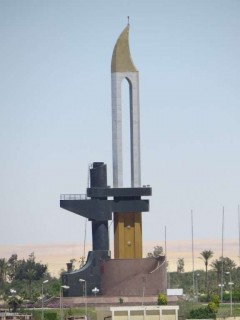
A huge monument of an AK-47 muzzle and bayonet stands out on the barren landscape of the eastern bank on the approach to Ismailia. The AK-47 monument commemorates Egyptians that died at the Battle of Ismailia. This battle took place between the Egyptian Army and the Israeli Defence Forces during the last stages of the 1973 Arab-Israeli War, south of the city on the west bank of the canal.
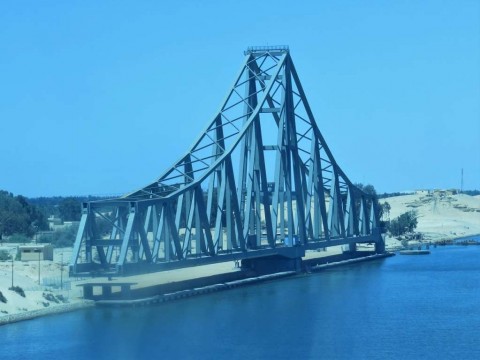
Next, the El Ferdan Railway Bridge, claimed to be the longest swing bridge in the world, with a span of 340 metres. Now obsolete, it is no longer in use after the Suez Canal expansion cut off the adjoining railway track.
The next point of interest on this route is El Qantara, a city that inhabits both sides of the Suez Canal. The city is linked by the multi-named Mubarak Peace Bridge, also known as the Egyptian-Japanese Friendship Bridge, the Al-Salam Peace Bridge and, more simply, the Suez Canal Bridge. It was opened in 2001 after Egypt received funding from Japan to assist the development of the Sinai Peninsula.
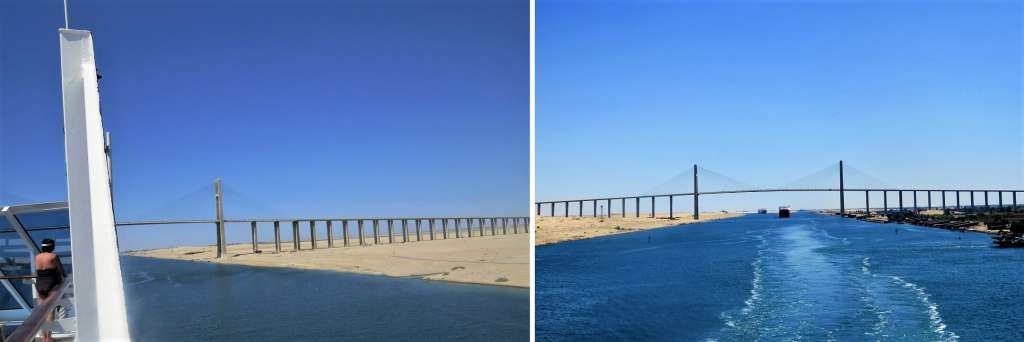
The cable-stayed bridge has a 70-metre clearance over the canal, allowing ships that pass under it to have a maximum height of 68 metres above the waterline. Egypt is one of a handful of countries that occupies two continents, with the mainland being in Africa while the Sinai Peninsula is in Asia. The Suez Canal Bridge therefore provides a road link between Africa and Asia.
Now approaching Port Said, the Soldier of Freedom monument can be seen on the starboard side. This monument is about the 1956 conflict known as the Suez Crisis, a complex entanglement that involved several nations and threatened world peace, before it was resolved in March 1957.
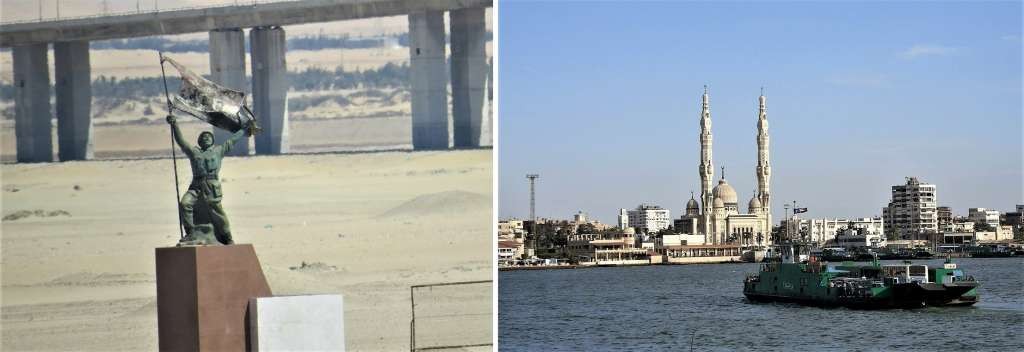
Port Said is the fifth largest city in Egypt and was built purely because of the Suez Canal. You can view the city on the port side of the ship when transiting northbound.
Directly opposite Port Said is Port Fuad, its twin city. You may see free ferries which link the two cities crossing this part of the canal.
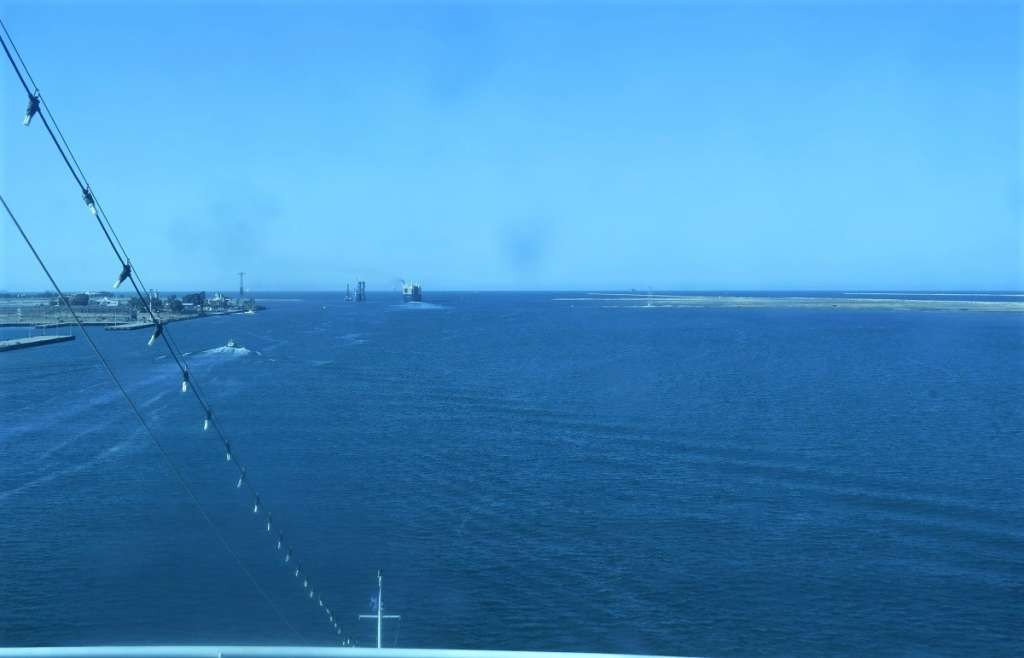
Finally, at about 5.30pm, we were out into the wide open Mediterranean Sea and heading for our next destination – Paphos in Cyprus, about 300 nautical miles north or 15 hours cruising. Our passage through the canal cost the ship's owners more than $200,000 in transit fees.
Photos © Judy Barford
Useful links
Location (Map)
When you subscribe to the AllWays Traveller, we will send you an e-mail when there are new updates on the site so you wouldn't miss them.
About the author

Contact info

ISSN 2634-7032
London, United Kingdom
+44 0 7764 198 286