AllWays Traveller Features
Break The Chains

Deathly pale and morose, which seemed befitting from what once lay behind her walls. Even the ocean was angry, slamming into her like a quarter-back going for the touch-line.
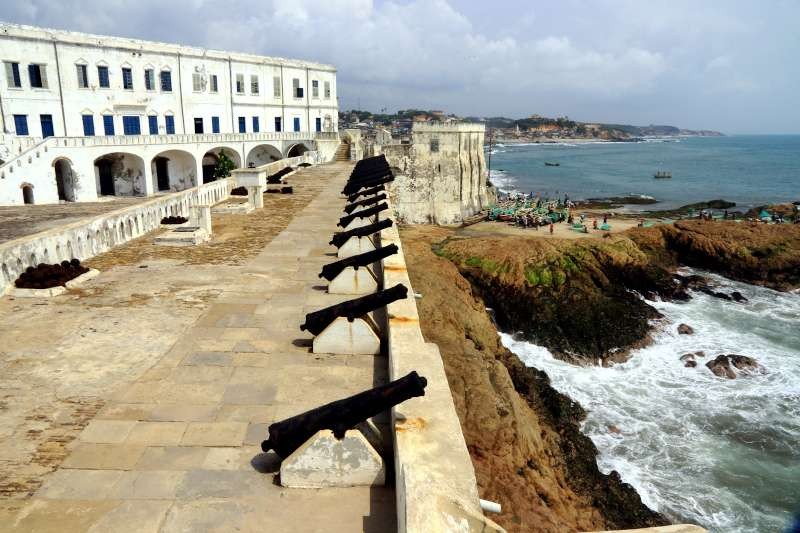
As one scrambled further up the rocks, the field of vision stretched across the ramparts, canons, and the austere white block at its core.
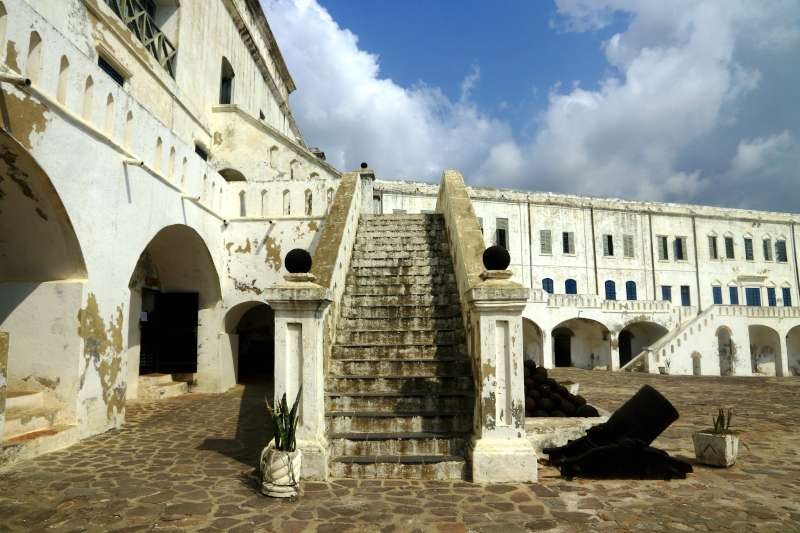
The warm evening light could only diffuse its facade, but not its history. As this colossal structure, staring out to sea with all the misery and despair soaked into its bricks, was the formidable Cape Castle.
One of many slave forts constructed along the coastline of Ghana, from Fort Apollonia near the Ivory Coast to Senya Beraku in the east.
Rising and falling like the waves, the town of Cape Coast spreads across a succession of small hills. Giving incredible peeks across crumbling colonial buildings, flat tin-roof houses, and the cramped fishing communities further out. An array of churches founded during British times, now accord a wealth of different branches of Christianity. Pentecostal, Methodist, Evangelical, Anglican, and Presbyterian with a proud green and white mosque in the centre.
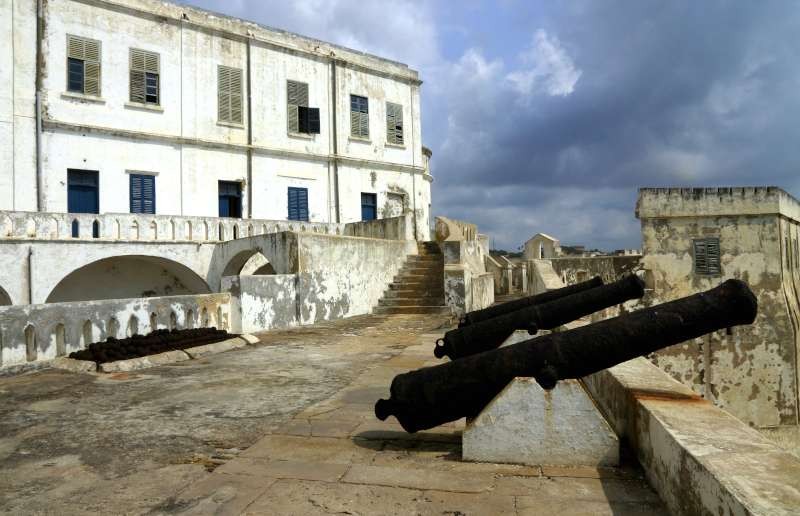
However, religion aside it is the Cape Castle, a white fortress on the southern side of town, forged on the coastal rock, that holds the most potent role here. A stark reminder to its bleak character, an instrument in fuelling and profiteering the inhumane slave industry. But now, the battlements and dungeons, those rows of rusting canons and slivers of light, are employed to the advantage of education.
Striking a shocking chord, many arrive to review the compelling evidence of what our white forefathers were capable off – often performed in the name of God. While for African-Americans, undertaking a personal, emotional and spiritual odyssey for truth, it might provide a chance to find explanations.
Once you have left the long white corridor that connects the main gate to the rear square, you form a small group and become part of a tour. The guide immediately descends to the male holding cells. The fort's construction incorporated a hierarchy both on a human and a religious position. African slaves, strangers to white man's God, were regarded as barbarians. In stark contrast to the civilized whites, who resided in the levels high above -affording them closer contact to heaven.
The holding cells, five in all, were joined to form a single line. Each held close to two hundred men, barely affording enough room to stand. Three small openings close to the ceiling offered minuscule light and ventilation. Captives were held here twenty fours a day, seven days a week, until the ships were ready to sail. It wasn't unusual for several months to elapse. There were no facilities for sanitation aside from a narrow channel around the edge of the cells.
Such a damming fact rendered the cell silent, and one felt the rising burden of humidity just then. All eyes scampered across the walls and floor in a nervous exercise to avoid eye contact. The guide let the moment linger — a professional not needing to pass criticism or judgement.
From these cells and others established only for women, the slaves were lead through a corridor to a single small room at the eastern end. In its wall stood 'The Door of No Return' where captives faced the toiling Atlantic, with its waiting ships ready to take them on the middle passage to the Americas. On the reverse side of the door hangs a small black sign announcing a signal of hope. 'The Door of Return', marking an episode, where many freed slaves after emancipation returned to Africa. Finding a new life on African soil, either in Sierra Leone or Liberia.
Along the ramparts, piled high like market coconuts were scores of cannonballs. They could reach a distance of one kilometre when fired against the challenge of a foreign takeover. Hostile powers, advancing by ship to seize the lucrative slave trade and the chain of forts for themselves.
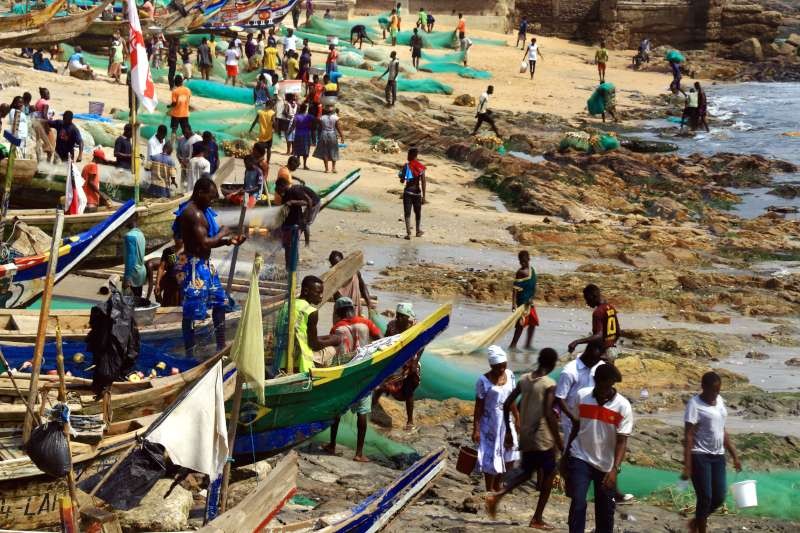
Beneath the fort, the tide was out, and several fishermen hurried to haul in the nets. On exposed rocks, several women washed the catch in bright plastic buckets. Their vigour and energy distracted most of the visitors away from the sombre history lesson up here.
With ascension came improvement, fed by a wooden staircase to the staff quarters. Soldiers took their meals in a great wood-floored hall flanked by large open windows. The officers would dine in even better surroundings alongside the governor in his private residence, located up a further flight of stairs. Where his title benefited a spacious lounge, bathroom, a well-aired bedroom and separate dressing area.
The tour, almost to end, entered one final room, a vast eloquent hall where dozens of slaves were washed, fed, oiled and massaged to look their best. Transferred to auction, where again their lives changed hands — becoming official property of a master. As we see it now, the illegal kidnapping, the illegal detention for the ocean voyage and illegal ownership that were all highly legal within the colonial duplicity of law. Their fate, future, misery, lay in a single person's hand who dealt his fancies and cruelties (both the same to many) in a pivoting manner between emotional and arbitrary.
Change was in the air, battling against the smoke of coal-happy London. Momentum against the slave trade had been gradually taking form. Public opinion, swayed by the passionate speeches and actions of William Wilberforce, Granville Sharpe and Thomas Clarkson, no longer viewed slavery with casual indifference. A double levelled deck plan of a slave ship showed the cramped head to toe conditions of 600 slaves, shackled to their neighbour for the entire voyage. It became a tremendous anti-slavery tool for pushing abolition further into the public consciousness. Similar to Joshua Wedgewood's design of a black man in chains, underscored with 'Am I, not a man and a brother'.
Sugar boycotts were encouraged against the exploitation of the plantations. The government, long apathetic due to personal stakes in the plantations, finally relented, bringing abolition into legal effect. Once passed as law, Britain pursued its new course with authoritarian force. Not just freeing her slaves but patrolling the high seas to capture other vessels as well.
In the long gloom of the fort's museum, unfolded the brief but exceptional stories of three former slaves. Incredible and inspirational in their unwavering beliefs and actions.
Harriet Tubman (1821 – 1913)
In 1846, Harriet managed to escape from slavery. Heading North she became the conductor of the Underground Railroad, completing 19 missions to the South to bring freedom to other slaves. Known as the 'Moses of her people', she led more than 300 people out of bondage. Harriet was soon taking people to Canada to overt new laws placed on the capture of escaped slaves. As she dryly stated 'I wouldn't trust Uncle Sam with my people any longer, but brought them all clear off to Canada.' Obtaining a bounty of $40,000 on her head, she continued regardless, to fight and support the cause for freedom.
Sojourner Truth – (1797 -1883)
Born as Isabella Von Wagener, a slave in New York state, she was freed in the 1820s from 'manumission' laws which granted freedom over a certain age and after a period of years. Wagener lived to see the end of slavery, changing her name to Sojourner Truth to cement her belief in the sacred call of God and tirelessly pushing for abolition and women's rights. Part of her freed life was absorbed in searching for her eight children, from which Truth was reunited with four of them. She penned much of her memoirs to help support herself.
Frederick Douglass – (1817 – 1895)
Born a slave in Maryland, with his father as his owner. Self-taught to read he escaped in 1838 with a freed black woman, Anna Murray who became his wife. Douglass went on to become a great orator, newspaper founder and activist. Protesting for the end of slavery alongside civil rights and rights for women. After the American Civil War, he became the Minister to Haiti. Douglass lived to see the end of slavery but never gave up fighting for greater rights. When asked what young people could do to help, he replied 'Agitate, agitate, agitate.'
From slavery to awareness, the imposing bulk of Cape Castle can now help shape the minds of future generations. Preventing such dark histories the capabilities of retaking root. As travel brings you frequently into the past with its modern implications, it is one of the many variations that conspire to educate and restructure human ideas of the world.
Above & Beyond
Cape Coast lays roughly three hours West from Accra and can be reached by coach, chartered taxi, and public minivans known as tro-tro's from around Kwame Circle and Kaneshie Motor Park in Accra.
Oasis Beach Resort – www.oasisbeach-ghana.com ( 024 5128322) (0243022594) has private room's starting at 140cd per night, a four-bed bedroom from 200 cd per night and self-contained bungalow with AC for 270cd, as well as dormitories (45cd ). A sizeable beachside bar and restaurant serving homemade wood-fired pizzas, grilled meats and fish. Perfect location right by the Atlantic with sea breezes and a wide sandy beach. Friendly staff make Oasis popular with both foreigners and Ghanaians. Note that Oasis Resort does not accept Credit cards. Payment is in cash, but they accept dollars, euros and sterling cash.
Baobab Lodge – www.baobab-children-foundation.de ( 054-0436130) Commercial Street. Small rooms available ( 50cd/60cd/70cd) with a great little cafe downstairs. Offering organic vegetarian foods, homemade juices and cakes, plus a shop dealing in locally made textiles, aromatherapy medicines, moringa, honey, and oils. Profits go to help fund the Baobab Children Foundation for disadvantaged and disaffected kids.
Daytrips – Elmina ( The Mine – after gold was discovered in the area), 18km further west can be reached by shared taxi from the Cape Coast taking less than an hour. The magnificent white fort of St. George (40cd) is noticeable as you enter the small town. Tours operate in similar scope to Cape Castle. El Mina has a very lively fishing port, the small hill fort of St. Jago and various 'posubans' – Asafo military company shrines.
Useful links
Check out www.ghana.travel for further information.
When you subscribe to the AllWays Traveller, we will send you an e-mail when there are new updates on the site so you wouldn't miss them.
About the author

Contact info

ISSN 2634-7032
London, United Kingdom
+44 0 7764 198 286