AllWays Traveller Features
Selling Voodoo in Togo

Boar skulls, calcium white with worn teeth and coat-peg tusks, lay side-by-side with neat uniformity more aligned to a library, museum or a churchyard.
Though sight had long since dissolved, one felt a peculiar charge cloak your back, of being followed, but not analysed.
Decay hung in the air, heavy and pervading, impossible to shake off like a mist or a chill, but it wasn't death; it didn't signify an end, an absolute, for this is West Africa's largest fetish market, based in Togo's capital Lomé.
The 'Marche des Feticheurs' founded in 1863, provided all the charms, talisman and priest-governed rituals in line with Voodoo.
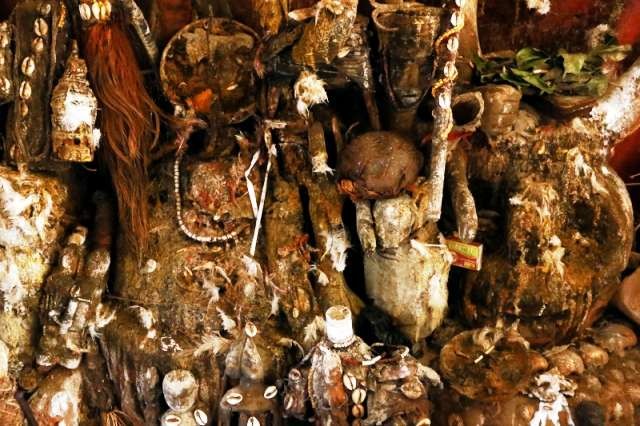
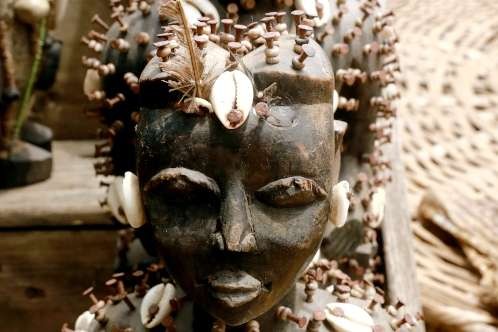
On the table opposite, a monkey's face looked up at the sailing clouds, its glassy eyes incapable of recognising colour and movement.
Laying there, from its bed of dried and coiled snakes skins, a pair of dulled incisors clasping two tobacco-red teeth, hair brushed outwards from a flaking forehead, manifesting an appearance reminiscent of a Halloween mask.
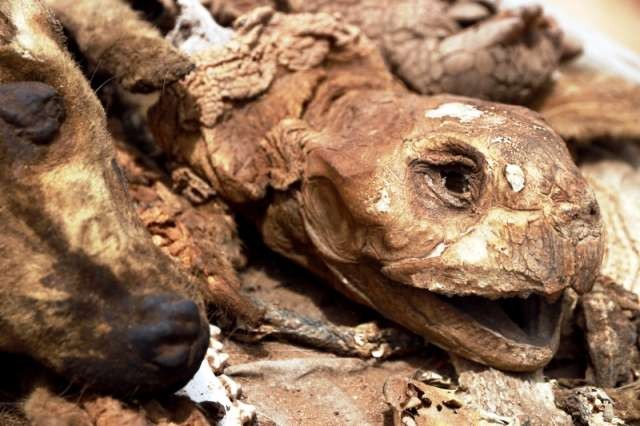
As I turned around, my eyes caught sight of another little primate sitting on its bench, hollow and dried to a smokey yellow, looking out in mummified silence to a dozen people beyond, mimicking a tired, worn appearance of an over loved toy.
A sickly macabre look that high-class Victorian society would have enjoyed before despatching it to a trunk in a gloomy attic.
Return to an equal balance
Death could heal and cure. It could revive and renew life back to former vitality.
The monkeys, snakes, and skulls, that lay alongside a dizzying array of other animal and bird parts, held the key to unlocking health benefits, realigning mental imbalances, spiritual protection, invoking love and securing success.
Possessing essential qualities from a medicinal and spiritual perspective that many in African society hold an unfailing belief in, maintaining it as a way of life than solely a religion or medium.
The root of Voodoo
'Everything' at the fetish-market 'came from Benin', assured Adam, my six-foot guide whose physique looked more at home in a boxing ring than a dusty city market—having crossed the busy little border that paralleled the Atlantic.
Voodoo, also recognised as Vodou and Vodoun, came from Benin during the reign of King Bienze, taking form at a time when there were no hospitals in Africa.
When the sick, for the first time, consulted with the Voodoo priest, their names incorporated into the ritual, making it highly personalised.
After consultation, the priest would decipher the appropriate prescription, sometimes using animal parts to concoct an ingestible medicine or through a talisman worn on the body.
Misunderstandings
One could only be born as a Voodoo priest, but a priest could teach his son, succeeding him in death.
Voodoo, meaning protection, represented the Almighty God and the four elements of fire, water, wind and air, activated by signing the cross over one's face.
Through misrepresentation in film, Voodoo suffered from a negative front, endorsing black magic and witchcraft in acts of violence and painful revenge.
A calculated error to promote sensationalism and drama had pushed Adam to elucidate somewhat frustratingly 'that Voodoo is never used to invoke pain through curses or cause continued suffering or violent death.
Voodoo is the reverse, used as a protection against such evil and matters in one's health, to encourage success in the pursuit of love, safe travel and paying homage to the ancestors.'
In Togo, most people still adhere to this traditional practice of animist belief; even many Christians and Muslims incorporate the rituals into mainstream doctrine.
People come here from as far afield as Gabon and both the Congo's, from Burkina Faso to the Ivory Coast.
All things metal
I left the long table of sun-baked skulls, passing a leathery old tortoise made solemn by sunken eyes and a gaping mouth, as if he had been rudely interrupted halfway to somewhere.
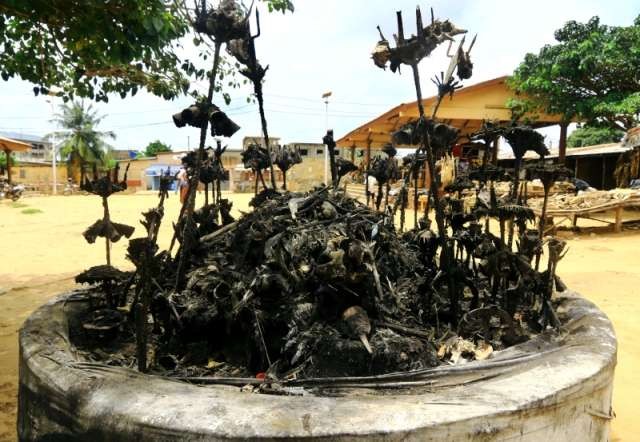
At the far end of a stall displaying wooden dolls stood a large circular pit filled with metal altars in the shape of King Neptune's trident, piercing burnt fragments of animal sacrifices that honoured the God of Iron.
In homage to the artisans, both living and ancestral, whose trade related to the profession of metals: blacksmiths, mechanics, dentists, doctors, chemists, and artists.
In the hands of the young
By mid-morning, the humidity is punishing, heightened by the coastal breezes that hamper rather than refresh.
I notice a pair of guides racing to the entrance to intercept a small group of French tourists passing through the gates.
I'm fortunate to know that Adam is the only English speaking guide here, putting to rest my rickety French.
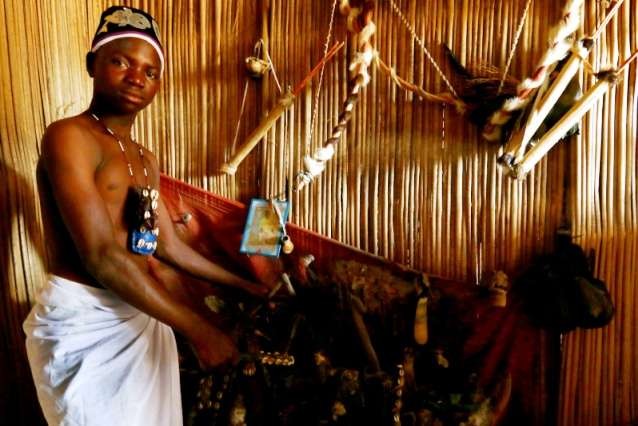
As we move back towards the wooden dolls, a teenage boy in a white toga, black hat and a necklace of cowrie-shells disappears into the gloom of a small room to our left.
I already know before Adam's confirmation that the boy is a priest, heading into his consultation room lined with all manner of remedies.
Twins and threes
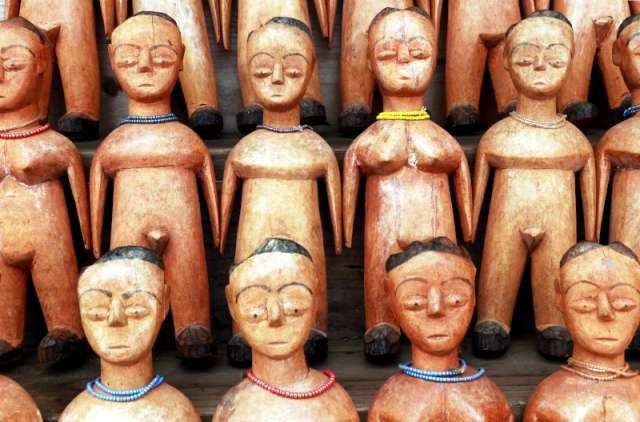
Rows and rows of poker-faced little dolls are all looking ahead like spectators to an invisible show. Some in blue dresses, some hammered with nails, most just naked with only a loop of beads. Paired together, they symbolised the birth of twins from where the mother must conceive a third to close the hole.
Though there was no further elaboration, I gathered it was to seal a weakness in the protective shield.
The mother would name her third child Edcha; boy twins carried the names Aquete/Aquete (stress on the final e of the second child) and Akoco/Akuele if they were female.
Every year, a ritual sees the dolls covered in red oil, alcohol and consecrated with prayer, continuing the children's protection against evil spirits.
If a mother loses her child, she must buy a new doll, visit the voodoo priest and attach the figure to her waist until she conceives again.
Animal magic
The practices and prescriptions were as varied as they were mesmerising to Western eyes, whose medical practices ascend from science and facts with no room for spiritual influence.
The long backbone of a snake worn as a necklace, would help combat rheumatism and arthritis; a live chameleon kept in bathwater for seven days could turn evil spirits into good; once the inflicted had bathed in the same water.
The power extracted from the mightiest animals afforded protection from witchcraft, imbibed by a potion made from the foot of a lion, leopard skin, hyena, elephant and baboon: all the great predators that roamed the wilderness.
Lucky number seven
There were seven different talismans, affording specific benefits to the owner, either held or worn like an amulet.
1.Sadame - Travelling protector
A small piece of hollow wood, much like a whistle with a tiny plug. You spoke your wishes into the hole, inserted the plug, kept it on you during travelling, then released the plug at your destination.
2.Dagbakui Queen
An ebony seed offering memory retention and protection against bad dreams, popular when studying for exams.
3.Tila
A tiny pouch stuffed with 41 different leaves with cowrie shells on the outside, which protects against poison when worn like an amulet.
4.Wanyinou - The fetish of love
A single person looking for love places three drops of perfume on their left hand, speaks their lover's name three times and their own four times, then places additional perfume over their body before going to meet their intended. Shaking their hands would pass the scent over.
For a couple prolonging their marriage, the woman holds the fetish (two dolls, male and female, face to face) in their left hand while the man places three drops of perfume and calls his wives names three times.
he act is then reversed, followed by the sprinkling of perfume on each other. The fetish is then thrown into the sea, symbolising a spirit going forward.
5.Lehba – known as 'back to the sender'
A small clay figurine with leaves sealed inside. A cigarette is ignited and left to burn in its mouth, used as protection against thieves.
6.Kpedo - (Viagra)
A piece of wood (Gbanguinah) is placed in alcohol for thirty minutes, removed from where the drink harbours greater potency.
7.Aylekete (King) & Avlessi (Queen) protectors.
Meeting the priest
I follow Adam, crossing from harsh sunshine into the poor light of the consultation room.
The same boy, barely a teenager*, stood in the corner brandishing an animal-hair whip, his feet planted amongst a jumble of fetishes, some I have seen on the stalls outside, but others are new, set out like trophies.
I take a seat, welcomed in by a rhythm of chants and prayers, but to my unaccustomed ears, I can not decipher the difference.
A selection of talismans are placed into my cupped hands; the boy leans in, smiles, exposing a set of extraordinarily white teeth while closing my hands under a further prayer.
I blow on my hands to seal in the blessing.
Adam explains the priest's advice to nominate the talisman I wish to have. The price starts at 30,000cfa, far too high. So the priest consults a group of cowrie shells, shaking them like dice across the floor.
He nods his head in pleasant surprise to their favourable position. The price drops, but it is still unobtainable, so I omit two talismans and stick with the final two that bear purpose to my journey; Sadame, the travel protector and the Dagbakui Queen, a polished ebony disc that I hope will strengthen my learning.
The shells roll again, their position this time isn't so advantageous but in keeping with good business practises a further discount arises. I can buy both for 5,000cfa. Quite a drop, and I thank the cowrie shells for their encouraging behaviour.
With blessings already administered, the talismans are good for conduct. I take two final photos of the priest, smiling over his wall of fetishes, with his up-turned whip nestled in his white toga.
Open road, open mind
I leave the market and flag down a motorbike. Before mounting the rear seat I remove the Sadame, rub off any dust and whisper a request of safe delivery into the hole.
The plug is attached and I keep the talisman cocooned in my left palm. We manoeuvre down quiet yellow lanes before filing onto the main road.
The smell of the sea is growing in strength, mixing with petrol fumes and hot tarmac.
I wonder if the Sadame is really at work, but like any religion or rite, it comes down to belief, where magic and power can only enter an open mind. It's one of the reasons to travel, so with this in mind, it's worth being open.
Above & Beyond
In spring 2021 the travel industry had yet to recover from the Covid-19 pandemic.
www.gov.uk for the latest advice.
About Togo
Togo, a West African nation on the Gulf of Guinea, is known for its palm-lined beaches and hilltop villages.
Koutammakou, inhabited by the Batammariba people, is a traditional settlement of fortresslike clay huts dating to the 17th century.
In the capital, Lomé, are the multistory Grand Marché bazaar and the Fetish Market, offering traditional talismans and remedies relating to the vodun (voodoo) religion.
The following information should resume once travel restrictions are fully lifted and normality resumes.
The market is authentic, but tourists pay an entry fee of 2000cfa which includes a guide.
An additional 3000cfa for photography allows you to walk around quite freely and take photos of the displays.
If you have a consultation with the priest and buy the odd talisman, you can take pictures here as well. Prices are negotiable for the various amulet, and it is worth taking your time as prices fall substantially.
Known as the 'Marche des Feticheurs – Akodessewa' and located near the city centre, every motorbike (zemidjan) and taxi driver knows its location. Give yourself a few hours to take it all in. Visit early morning to late afternoon to avoid the heat.
Flights to Lomé go via Paris, Morocco and Brussels. Tap (Portuguese Airline discontinued their service in October 2020 – lack of demand).
You could pick up a cheaper flight to Ghana and go overland from there, but you will need a visa for Ghana before you depart.
The Togolese Embassy : www.togoembassylondon.com
A Yellow Fever Certificate
Anywhere in West Africa requires a Yellow Fever Certificate.
It is now valid for life and not ten years like it used to be.
The WHO confirmed this as fact (worth viewing on their website), and so far, while crossing many African borders, no official has ever challenged me over the certificate.
Current exchange rates:
£1 =757cfa
$1=547cfa
1Euro =655cfa
Lomé has plenty of hotels with prices starting from 11,000cfa per night.
Booking.com and Airbnb are good places to start as they cover a greater range from budget to high end.
Useful links
Location (Map)
When you subscribe to the AllWays Traveller, we will send you an e-mail when there are new updates on the site so you wouldn't miss them.
About the author

Contact info

ISSN 2634-7032
London, United Kingdom
+44 0 7764 198 286